What an AEO Specialist Actually Does: 40 Job Postings Read
An AEO specialist is mostly an SEO who can also measure AI answers. I read 40 remote job postings to see what employers ask for, which tools they name and what they pay, then laid out the weekly work the postings describe, with examples from my own.

Table of Contents9 sections
Real tests on Claude and SEO tools, with the numbers and what failed. About once a week.
Almost there. Check your inbox and click the link to confirm. Not there in a minute? Look in spam.
Something went wrong on my side. Try again in a minute.
Too many tries. Give it a minute.
That email doesn't look right. Check it for a typo.
Unsubscribe anytime. Privacy

I read 40 remote job postings for AEO, GEO and AI search roles. Then I coded every one: the asks, the tools, where you can work from, the pay.
I'm looking for one of these roles myself, so I had a reason to read them closely.
The short version: an AEO specialist is an SEO who also measures how a brand shows up in AI answers, and works to improve it.
Technical SEO and proven results were in almost every posting, and measuring AI visibility in more than three quarters. The title changes. The job underneath is still SEO.
Hiring for one, or applying? Jump to the weekly work, or to what to show in an interview.
Key Takeaways
- 34 of 36 core postings asked for technical SEO, and 34 for results you can show with numbers.
- 28 asked you to measure AI visibility: citations, mentions, share of voice.
- ChatGPT was named in 26 postings, Perplexity in 24. Claude Code in 5, all of them senior or in-house roles.
- "SEO" was in 31 of the 36 titles. AEO and GEO were close to a tie, 16 and 13.
- Most are US-only. 24 of 36 wanted you in the US or North America.
What I read, and how I counted
| Postings | 40 remote or remote-listed roles, live in 2026 |
| First read | 19 postings on 22 October 2026 |
| Re-check | 5 November: 14 still open, 2 changed, 3 closed or gone |
| Added | 21 new full-text postings on 5 November |
| Core sample | 36 (four neighbouring roles left out: two paid search, one content strategy, one marketing engineer) |
| Sources | Employer career pages and applicant systems (Greenhouse, Lever, Ashby), found through geojobs.ai, aisearchjobs.co and Remotive |
Each ask counts once per posting, and only when the posting says it.
OpenAI's Codex read and coded the re-check and the 21 new postings against a fixed list. My own script did the counting.
What employers ask for
Here's how many of the 36 core postings asked for each thing, in plain words:
| Ask | Postings (of 36) |
|---|---|
| Results you can show (traffic, sign-ups, revenue) | 34 |
| Technical SEO (crawling, indexing, structured data, speed) | 34 |
| Content strategy or writing | 31 |
| Dashboards and reporting | 30 |
| Measuring AI visibility (citations, mentions, share of voice) | 28 |
| Knowing how AI search finds and cites pages | 27 |
| Experiments with a stated method | 25 |
| Tying search to pipeline or revenue | 25 |
| Working with engineers | 24 |
| Schema, named on its own | 15 |
| Using AI tools or agents in your own work | 14 |
| Off-site work: Reddit, YouTube, digital PR | 12 |
Notice what's on top. The two asks every posting shares are the old ones: fix the site, and prove it worked. AI visibility sits fifth.
I see the same pattern in my own work. An AI answer is built from pages a search system already found, so the person who gets a brand into those answers is still doing SEO first.
The tools they name
| Tool | Postings (of 36) |
|---|---|
| ChatGPT | 26 |
| Perplexity | 24 |
| Google AI Overviews or AI Mode | 22 |
| Google Search Console | 20 |
| Gemini | 17 |
| GA4 | 14 |
| Semrush | 13 |
| Claude, Ahrefs | 9 each |
| Profound (an AI visibility tracker) | 8 |
| SQL | 6 |
| Claude Code | 5 |
| Python | 4 |
| Peec AI, Looker | 3 each |
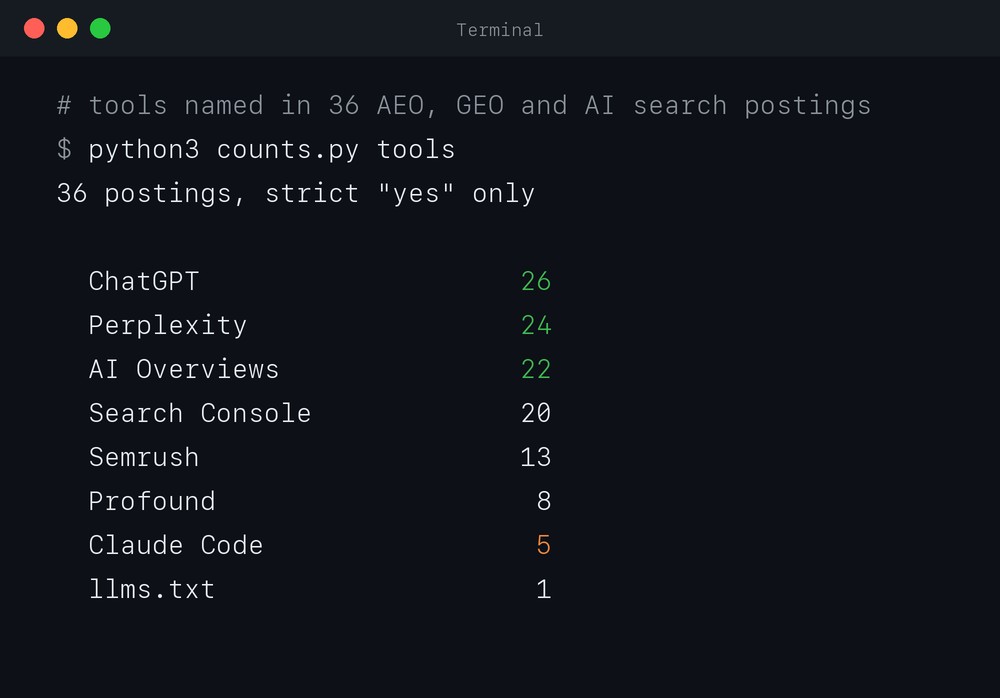
The assistants top the list as places a brand has to show up. Is that the same as using them? Hardly.
Fewer postings name the tools you'd use day to day. Only 14 asked you to use AI in your own workflow, and 5 named Claude Code.
Those five were all senior or in-house. One posting named llms.txt.
Titles, places and pay
SEO stays in the title. 31 of the 36 titles say SEO, and most add one more word: AEO in 16, GEO in 13, "AI Search" in 10. Spelled out, "Generative Engine Optimization" showed up once.
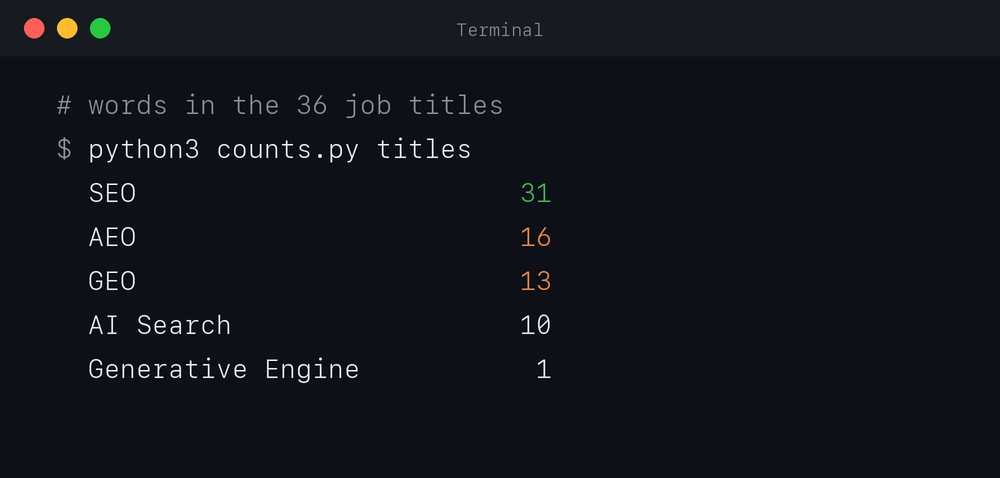
So employers are adding AI search to the SEO job. If you write a CV for these roles, say both.
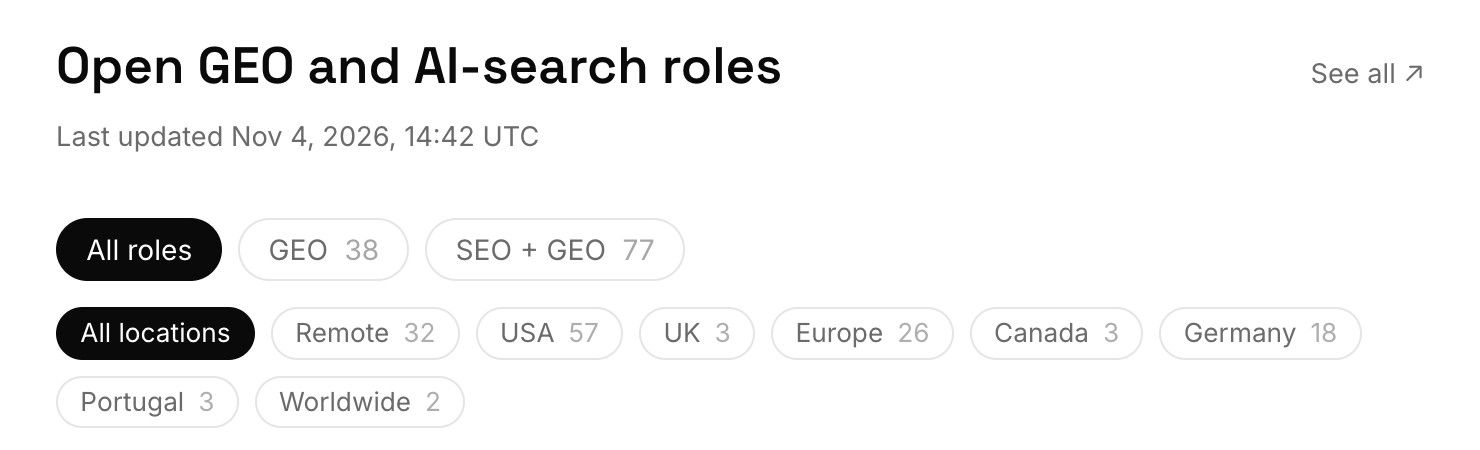
A separate snapshot of one job board points the same way. On geojobs.ai, 57 roles were in the USA and 2 were open worldwide.
Here's my own sample, by where you can work from:
| Who can apply | Postings (of 36) |
|---|---|
| US or North America only | 24 |
| Europe or one EU country | 3 |
| Latin America only | 2 |
| Worldwide or anywhere | 3 |
| Other or unclear | 4 |
That's the part that stings for me, working from Bali. Two in three "remote" roles meant remote inside the US or North America.
Pay was stated on 19 of the 36. A few, as advertised (the Seer and Selection Book listings had closed by 7 November):
| Role | Pay as advertised |
|---|---|
| Airbnb, Senior Growth Marketing Lead (SEO, AEO, GEO) | $196k to $245k, US |
| Babylist, Senior SEO & AEO Manager | $143,788 to $191,730, US |
| Single Grain, Senior Manager SEO/AEO | $100k to $150k |
| Seer Interactive, SEO & GEO Associate | $65k to $75k, US |
| Scento, Head of SEO & AI Search | €125k to €160k, EU |
| Selection Book, SEO & AI Search Manager | $3k to $4k a month, worldwide |
These aren't comparable with each other. Level, country and contract differ, so read them as the range of what's out there.
The work, week to week
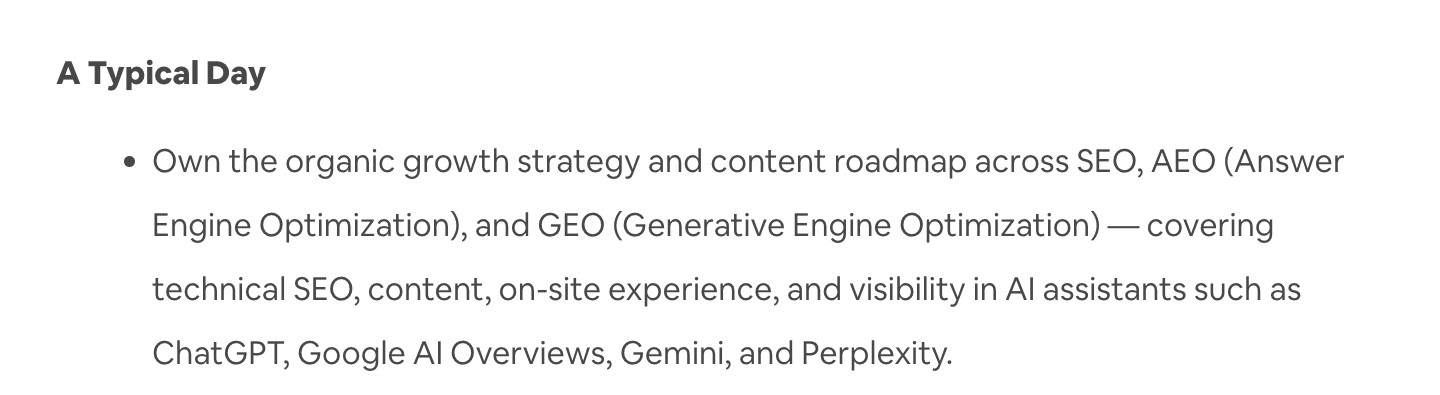
Airbnb's posting fits the whole job into one bullet. Together, the postings describe a loop. I've added an example from my own work at each step.
- Fix the question set. Write 10 to 20 questions the way a customer would type them, and lock the wording. My GEO vs SEO test used 20, asked in four assistants.
- Take a baseline. Answers move between runs, so ask each question several times, on more than one day, and record who gets named.
- Read the sources. When I compared Perplexity's sources with Google's top 10, only about 7% were the same pages.
- Fix the site. My AI SEO audit found a newsletter heading at the top of every post's outline.
- Deploy one change, and measure it the same way.
- Report it as a rate, tied to something the business counts: referral sessions, sign-ups, pipeline.
In my workflow, steps 1, 2 and 6 are the new part. Steps 3 to 5 are the SEO job, pointed at a new kind of result page.
What the postings ask versus what the evidence says
| Postings ask for | What I'd tell a hiring manager |
|---|---|
| Schema (15 of 36) | Useful for who you are, but Google says AI Overviews need no special schema |
| llms.txt (1 of 36) | Google Search ignores it. Fine to add, nothing to promise |
| "AI visibility" as one number | Report it per assistant and per question, as a rate across runs |
| Results you can show (34 of 36) | The right ask. Ask for the method behind the number too |
How to show the work
Applying? I'd bring these four, in this order:
- A number you moved, with its window. "Organic sign-ups from 120 to 310 a month, March to August" beats "grew traffic".
- A test you ran, with the question list and the raw answers.
- A fix you deployed, with the before and after.
- The tools you've actually used, each with one thing you did in it. Mine for Semrush is checking 117 of its numbers against Keyword Planner.
Hiring? Ask for the same four. The question list gives a candidate away fastest: a vague one means they've never measured an answer.
My own are on my AI search page, and the roles I'm open to are here.
Common Questions
What does an AEO specialist do?
An AEO specialist does SEO with one more goal: getting a brand named and cited in AI answers from ChatGPT, Perplexity and Google. In 36 remote postings read in November 2026, 34 asked for technical SEO and 28 for measuring AI visibility.
Is AEO replacing SEO in job titles?
No. In 36 remote AEO, GEO and AI search postings read in November 2026, 31 titles still included SEO. AEO appeared in 16 titles and GEO in 13, usually next to SEO rather than instead of it.
What tools does an AEO specialist need to know?
Employers name ChatGPT, Perplexity and Google AI Overviews most, as places a brand must appear. In 36 postings, Search Console was named in 20, GA4 in 14, Semrush in 13, Profound in 8 and Claude Code in 5.
Are AEO and GEO jobs open to remote workers outside the US?
Few. Of 36 remote AEO, GEO and AI search postings read in November 2026, 24 were limited to the US or North America, 3 to Europe, 2 to Latin America, and only 3 were open worldwide.
I run real tests on Claude and SEO tools, like 10 voice models on one Mac or 25 audits of a site with 20 planted problems. You get the numbers, including what failed. One email per post, about once a week.
Almost there. Check your inbox and click the link to confirm. Not there in a minute? Look in spam.
Something went wrong on my side. Try again in a minute.
Too many tries. Give it a minute.
That email doesn't look right. Check it for a typo.
Unsubscribe anytime. Privacy