How Perplexity Picks Its Sources: A 20-Question Test
Perplexity doesn't publish how it picks sources, so I measured it. 20 questions, 200 sources, every page checked against Google's top 10. Only about 7% were the same pages, and the ones Perplexity chose were twice as fresh.

Table of Contents8 sections
Real tests on Claude and SEO tools, with the numbers and what failed. About once a week.
Almost there. Check your inbox and click the link to confirm. Not there in a minute? Look in spam.
Something went wrong on my side. Try again in a minute.
Too many tries. Give it a minute.
That email doesn't look right. Check it for a typo.
Unsubscribe anytime. Privacy

I asked Perplexity 20 questions about SEO and AI search, then wrote down every source under every answer. That came to 200 sources.
Then I matched 180 of them to their pages and compared those with Google's top 10 for the same question. Only 13 were the same page.
The short version: no published formula, and sources that rarely matched Google's top 10.
The pages it cited were fresher than Google's top 10, more often had a table, and leaned hard on vendor blogs. Want to know how much fresher, and how I counted?
Want the checks for your own pages? Jump to what it means for an SEO.
Key Takeaways
- 13 of 180 cited pages were in Google's top 10 for the same question. That's about 7%.
- The cited pages were fresher: half carried a date within 54 days of my test, against 110 days for Google's top 10.
- More of them had a table (54% against 39%).
- Vendor blogs were the biggest group, about 45% of the pages I could classify.
- Perplexity documents its crawlers. It doesn't document how it picks citations, so anything you read about "ranking factors" is a guess.
What Perplexity documents, and what it doesn't
Perplexity's crawler page is the only primary source here. It names two bots and says what each does.
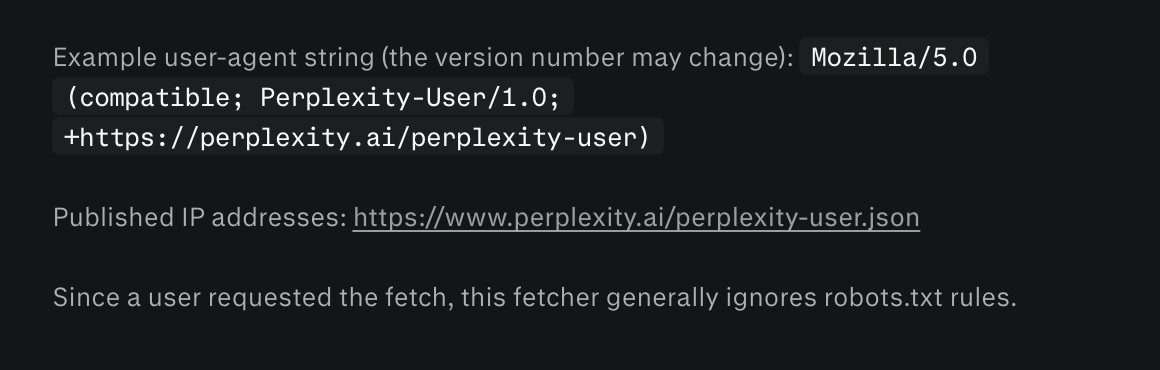
| Bot | What Perplexity says it does | robots.txt |
|---|---|---|
| PerplexityBot | Surfaces and links websites in Perplexity's search results | Managed with robots.txt tags, per Perplexity |
| Perplexity-User | Fetches a page when a user's question needs it | Generally ignores it, since a person asked |
That's it. There's no published scoring for which pages make it into an answer. Pages that list "the six stages of Perplexity's pipeline" are describing a guess, however tidy.
So I stopped reading guesses and counted.
How I tested 20 questions
| Where | The Perplexity Android app, Incognito Mode, signed in, from Bali |
| When | 26 and 27 October 2026, one run per question, a new thread each |
| Questions | The 20 from my GEO vs SEO test, typed exactly |
| Sources | The first screen of each Sources sheet, up to 10 per answer |
Top 10, signed out, hl=en&gl=us, the same days | |
| Pages | Measured on 5 November with one script, for both sides |
Three things count differently here, and mixing them up is how overlap numbers end up meaning nothing:
- A source is one entry in an answer's Sources sheet.
- A URL match means the exact page was in Google's top 10 for that question.
- A domain match means the same site was there, any page.
Perplexity showed sources on all 20 answers. I found the page for 180 of the 200. The other 20 I couldn't match to a URL with confidence, so they're left out of the page counts.
What the answers cited
Here's one answer's sources, after I matched each to its page:
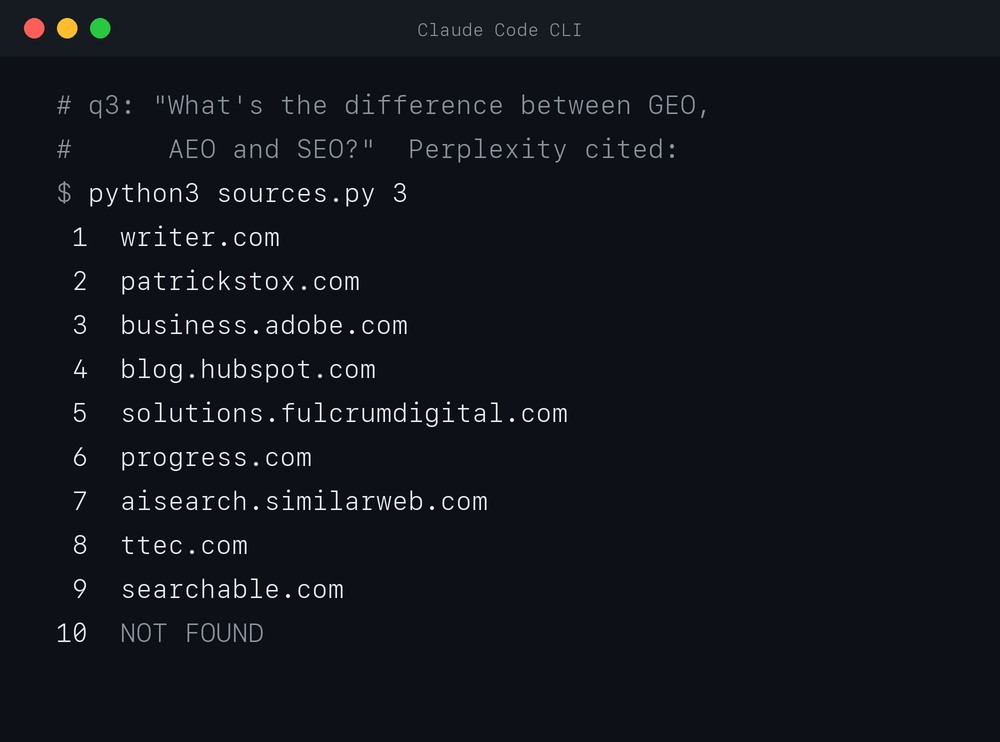
The spread was wide. The 180 sources I could match came from 134 different sites, and 116 of those sites turned up in one answer only.
A few came back again and again:
| Site | Answers that cited it (of 20) |
|---|---|
| HubSpot | 7 |
| Semrush | 6 |
| Search Engine Land | 5 |
| Google's own docs | 4 |
And here's the overlap with Google, both ways of counting:
| Match | Citations | Questions where it happened |
|---|---|---|
| Same URL in Google's top 10 | 13 of 180 (7%) | 9 of 20 |
| Same site in Google's top 10 | 19 of 180 (11%) | 11 of 20 |
For contrast, Google's own AI Overview cited a top-10 site more than 60% of the time on the same questions.
This test can't show what Perplexity searches with. It shows how little the two lists overlapped.
What kind of pages
For the first 16 questions, each page got a type:
| Type | Pages |
|---|---|
| Vendor (sells a tool) | 64 |
| Agency | 33 |
| Publisher | 27 |
| Official docs | 11 |
| Platforms like Medium, research, other | 8 |
In those 16 answers, vendors wrote almost half the pages Perplexity used to explain SEO and AI search. Ask it about a topic where software companies blog a lot, and it'll quote them.
What set the cited pages apart from Google's top 10
I measured every page that would load, on both sides, the same way:
| On the page | Cited by Perplexity (140 pages) | Google's top 10 (111 pages) |
|---|---|---|
| Dated within 90 days of the test (pages dated before it) | 68% (67 of 99) | 42% (31 of 73) |
| Median age of that date | 54 days | 110 days |
| Has a table | 54% | 39% |
| Has a list | 93% | 78% |
| Answers the question in its first 100 words | 70% | 64% |
| Median length | 2,500 words | 2,150 words |
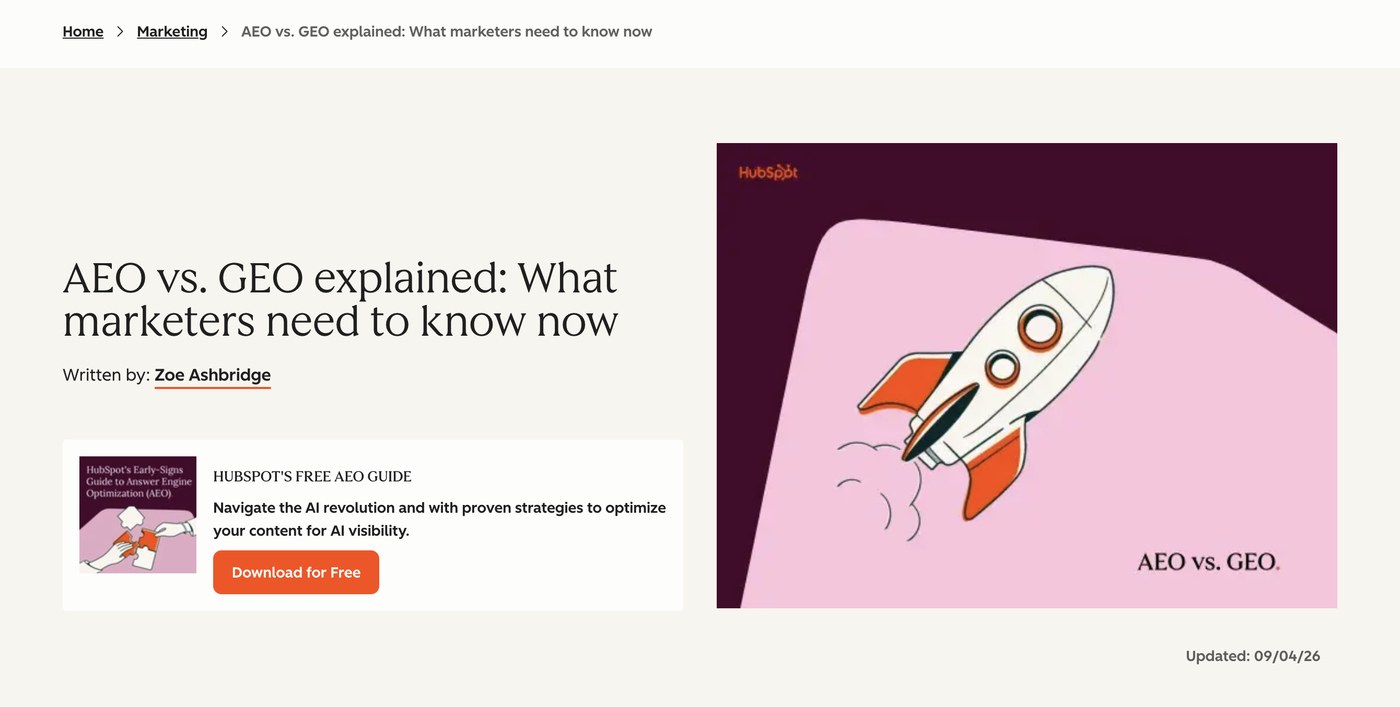
Freshness is the biggest gap. Two in three cited pages with a date had one from the three months before my test. In Google's top 10 it was about two in five.
HubSpot's post above was updated seven weeks before my test.
Tables come second: the cited pages had one more often. My guess is a table gives a model a clean row to quote, but this test didn't measure what got quoted.
Two rows barely move. Both sides were long, so nothing here says a short page wins.
And the direct-answer opening, the advice on every GEO checklist? Only six points apart. Most of Google's top 10 did it too, so it doesn't explain the gap.
These are patterns, not ranking factors
I can't tell you why Perplexity picked a page.
Fresh vendor pages with tables might win because of the date, the table, or because vendors write about this topic constantly. This sample can't separate those.
A different topic could look nothing like it. Would recipes or local dentists? I'd bet not.
Can PerplexityBot even get in?
Every page was also requested with PerplexityBot's user agent. Five cited pages answered it with an error while a browser got through:
| Cited page | Browser | PerplexityBot user agent |
|---|---|---|
| Salesforce blog | 200 | 403 |
| Print magazine | 200 | 403 |
| An SEO agency blog | 200 | 403 |
| Springer book page | 200 | 406 |
| A CloudFront-hosted blog | 200 | 404 |
That's a test from 5 November with a copied user agent, so it can't say what Perplexity met in October.
Still, a page can be blocked to the indexer and get cited anyway, because Perplexity-User fetches for the person asking.
What it means for an SEO
- Check both bots, in robots.txt and in your CDN's bot rules. My AI SEO audit has the commands.
- Put a real date on the page.
- Turn your best comparison into a table. If a reader would compare it, a model can quote it.
- Don't plan around Google's top 10. In this run, more than 9 times in 10 Perplexity cited a page that wasn't in Google's top 10 for the same question.
- Track it per question, many times. One run is a snapshot, and the answers move between runs.
- Do the same for ChatGPT, tracing each citation back to the page it came from.
Limits, and the files
- One run per question, and Perplexity's sources change from run to run.
- Only the first screen of each Sources sheet, up to 10 sources, so a few may be missing.
- Signed in, in Bali. Location and account change answers.
- Pages were measured on 5 November, ten days after the answers. 31 pages showed a date after the test (19 cited, 12 from Google), so they're left out of the date rows.
- The "first 100 words" row is a judgement, made page by page by an AI reader (OpenAI's Codex) with the same instructions for both sides.
- 20 SEO questions are one topic. Take the shape as a lead, not a law.
Common Questions
Does Perplexity use Google's top 10 results to pick its sources?
Rarely, in this test. Of 180 sources Perplexity cited on 20 SEO questions in October 2026, 13 were the exact pages in Google's top 10 for the same question, about 7%. Google's AI Overview cited a top-10 site more than 60% of the time.
What kind of pages does Perplexity cite most often?
Fresh ones, in this sample. Of the pages Perplexity cited on 20 SEO questions that showed a date, half were dated within 54 days of the test, against 110 days for Google's top 10. Vendor blogs made up almost half of the 143 pages classified, and 54% had a table.
Does Perplexity publish how it chooses which sources to cite?
No. Its crawler documentation explains PerplexityBot, which surfaces and links sites in its search results, and Perplexity-User, which fetches pages for a user's question. It publishes no scoring for which pages appear in an answer.
Can Perplexity cite my page if robots.txt blocks PerplexityBot?
Possibly. Disallowing PerplexityBot limits its crawler, but Perplexity's docs don't say that removes a page from its results. Perplexity says its Perplexity-User fetcher, used when a person asks a question, generally ignores robots.txt.