Semrush vs Keyword Planner: Why Search Volumes Disagree
Same keywords, same country, two very different numbers. I put 117 keywords through Semrush and Keyword Planner and counted where Semrush landed against Google's range. Mostly inside or above, rarely below.

Table of Contents8 sections
Real tests on Claude and SEO tools, with the numbers and what failed. About once a week.
Almost there. Check your inbox and click the link to confirm. Not there in a minute? Look in spam.
Something went wrong on my side. Try again in a minute.
Too many tries. Give it a minute.
That email doesn't look right. Check it for a typo.
Unsubscribe anytime. Privacy

Semrush says "seo audit checklist" gets 6,600 searches a month in the US. Google's Keyword Planner, set to the US, says 100 to 1,000.
That's one keyword. So I checked 120 of them, in both tools, with the country set to the US in each.
The short version: for 56 of the 117 keywords both tools returned, Semrush's number sat inside Google's range. For 51 it was above, often by more than double. Only 10 came in below.
Want to check your own keywords? Skip to how to rerun it.
Key Takeaways
- Semrush landed above Keyword Planner's range for 51 of 117 keywords, inside it for 56 and below it for 10.
- In my list, the gap was mostly on small keywords. Where Google said 10 to 100, Semrush was higher on 20 of 26.
- On keywords Google put at 10,000 to 100,000, Semrush was never above.
- My Keyword Planner showed ranges, not numbers, and suggested running a campaign for more detail.
- Change the location and Google's range moves too: 3 of 18 keywords dropped a whole band when I switched from four countries to the US alone.
What I found
Here's where Semrush's US number landed against Google's US range:
| Where Semrush landed | Keywords | Share |
|---|---|---|
| Inside Google's range | 56 | 48% |
| Above it | 51 | 44% |
| Below it | 10 | 9% |
When Semrush was above, it was usually well above. The median gap was about 2.4 times the top of Google's range, and 8 keywords were five times higher or more.
The pattern depends on size. Here's the same split, by the range Google gave:
| Google's US range | Keywords | Semrush above | Inside | Below |
|---|---|---|---|---|
| 10 to 100 | 26 | 20 | 6 | 0 |
| 100 to 1,000 | 53 | 27 | 21 | 5 |
| 1,000 to 10,000 | 29 | 4 | 23 | 2 |
| 10,000 to 100,000 | 9 | 0 | 6 | 3 |
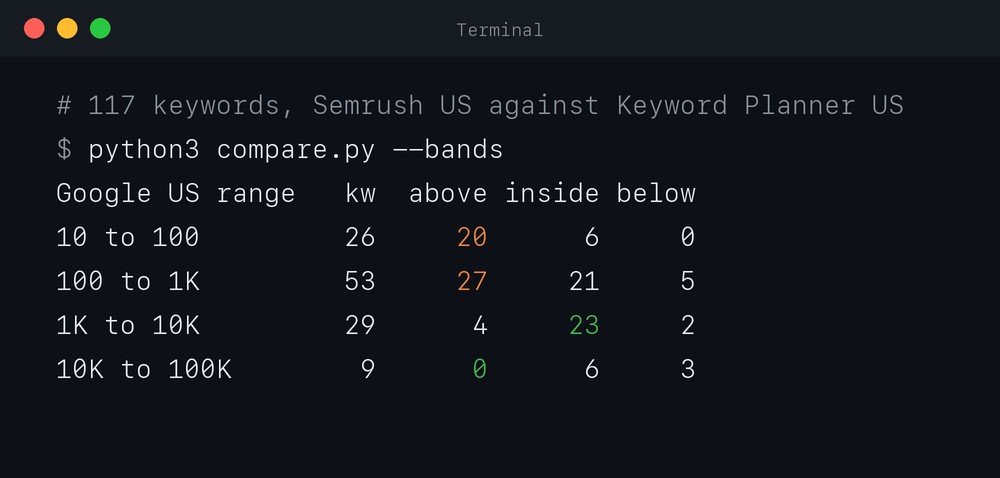
In this list, small keywords are where the tools fight. On anything Google rated at 10,000 or more, Semrush agreed or came in lower.
The widest gaps:
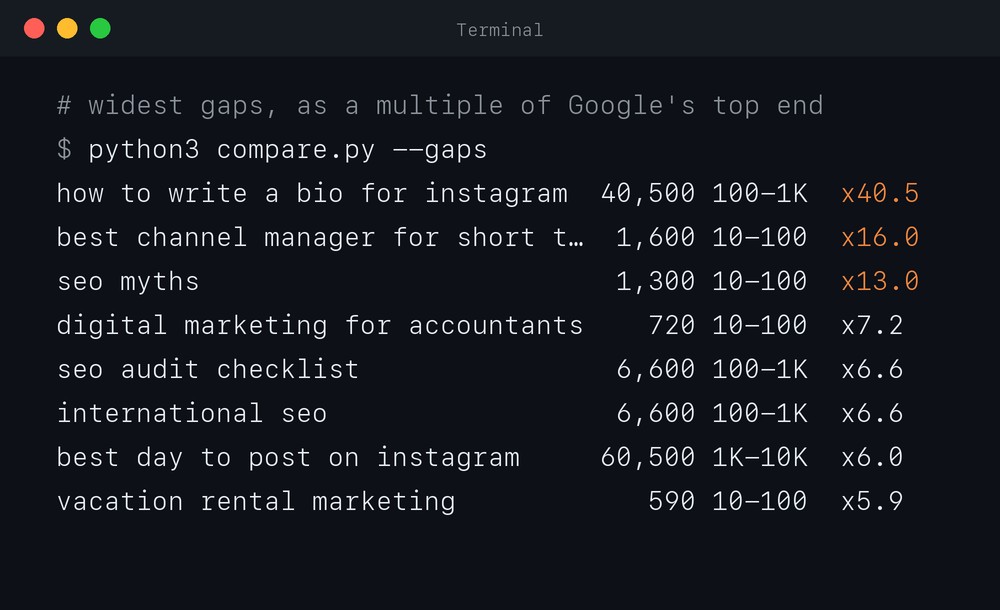
Five of them, side by side:
| Keyword | Semrush US | Keyword Planner US |
|---|---|---|
| how to write a bio for instagram | 40,500 | 100 to 1,000 |
| best channel manager for short term rental | 1,600 | 10 to 100 |
| seo myths | 1,300 | 10 to 100 |
| seo audit checklist | 6,600 | 100 to 1,000 |
| international seo | 6,600 | 100 to 1,000 |
My guess on the Instagram bio one (and it is a guess): one tool counts a family of searches the other splits up.
"Instagram bio" on its own gets 1,000 to 10,000 in Keyword Planner. Where each tool draws the line between close phrases moves the number a lot.
Why the two numbers can't match
They aren't measuring the same thing, even with the same country picked.
Semrush models its number. Its search volume help page says it feeds third-party and clickstream data into a machine learning model.
What you see is an average of the past 12 months, updated monthly.
Keyword Planner reports Google's average searches for a keyword and its close variants, for the months, location and network you set (Google's definition).
It also groups close variants. In my run, "booking.com vs airbnb" only came back as "booking com vs airbnb", one row for both.
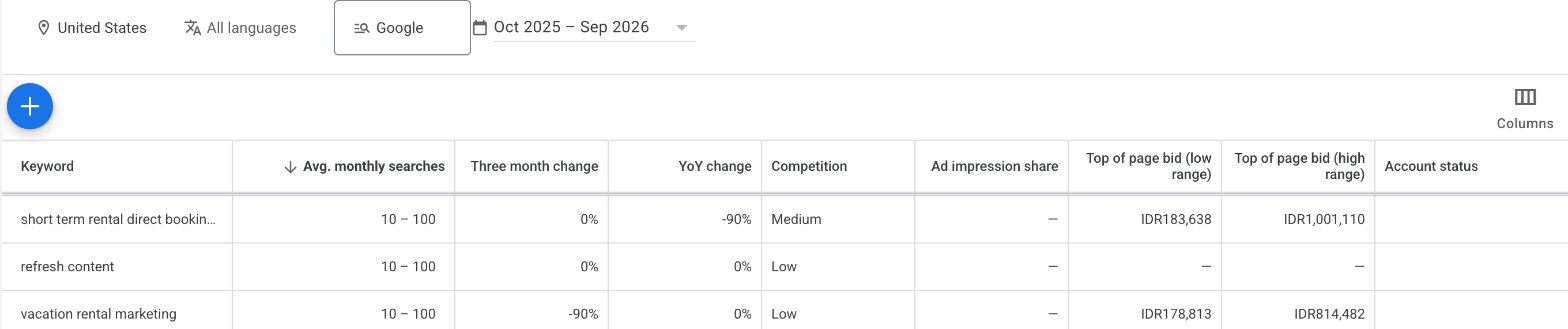
And my account only got ranges. When my results loaded, Keyword Planner said: "To get more detailed statistics, run a campaign."
My account showed a range of 100 to 1,000. An exact 1,600 looks more precise than it is, because Semrush's figure comes out of a model.
Three more things move the numbers before you even compare:
- Location. Keyword Planner starts on your ads account's country (mine is Indonesia). 18 of these keywords had an older US, UK, Australia and Canada reading: on the US alone, 3 dropped a band.
- Months. Semrush was read on 29 July and 4 August 2026, a 12-month average at the time. Keyword Planner covered October 2025 to September 2026.
- Language and network. I left Keyword Planner on all languages and Google search only.
Google's numbers aren't ground truth either. Ahrefs checked Keyword Planner against Search Console in 2021, on 72,635 keywords in the 1,000 to 10,000 range.
The planner came within 50% of Search Console impressions only about 45% of the time.
How I ran it
| Keywords | 120: the 20 that already had a Keyword Planner reading, plus 100 drawn at random from 314 that only had a Semrush figure |
| Semrush | US database, exact monthly volume, read 29 July and 4 August 2026 |
| Keyword Planner | "Get search volume and forecasts", United States, all languages, Google search, October 2025 to September 2026, read 5 November 2026 |
| Batches | Three batches of 40, typed in by hand |
| Compared | 117 keywords (two spellings Google returned as one row, counted once; one grouped into another keyword and not shown; one with no data) |
Then one rule for every row. If Semrush's number fell between the low and high ends of Google's range, it's inside. Below the low end is below, above the high end is above.
The keywords come from my own research for this site and mersa.biz: SEO, AI search, hotels, social media, Bali.
So the split above describes these 117 keywords and nothing bigger.
What 117 keywords can and can't tell you
So what do 117 keywords prove? That the two tools disagree often, and mostly one way: Semrush higher, on smaller keywords.
They can't tell you which one is right. Neither counts the searches you'll actually get.
Search Console counts an impression when a link to your site shows up in Google's results, so it measures your visibility, not the whole market.
So I don't read "above" as "Semrush is wrong". On a keyword Google puts at 10 to 100, Semrush's 260 could be closer to the truth, or a model guessing high.
My test can't separate those.
How I use each number
| Tool | What I use it for |
|---|---|
| Keyword Planner | Does the topic exist in this market? |
| Semrush | Which of these keywords is bigger, and who ranks? |
| Search Console | How often does my page actually show up? |
Keyword Planner first, for whether a topic exists at all in a market. It's Google's own data, and the range is enough to decide "worth a post" or "skip".
That's how I picked the topic for my Claude SEO skills test.
Semrush next, for comparing keywords against each other inside one tool, plus difficulty and what ranks now.
Holding Semrush's 1,600 up against Google's "10 to 100" and calling one of them wrong is the mistake.
Then Search Console, once a page is live. Impressions on a page that ranks on page one are the nearest I get to a real count for that one page.
And when the two tools disagree five times over, I open the search results and look. Who ranks, what kind of page, and whether the phrase means what I think.
How to rerun it
- Export 50 to 100 keywords from Semrush for one country database, with the date you exported them.
- Paste them into Keyword Planner's "Get search volume and forecasts" and change the location to the same country. It won't match by default.
- Write down the month range Keyword Planner shows, and the language and network.
- Mark each keyword inside, above or below Google's range, using the same rule for all of them.
- Look at the keywords five times apart in a real search before you trust either number.
Common Questions
Why is Semrush search volume higher than Google Keyword Planner?
Often it is, on small keywords. In my check of 117 keywords set to the US, Semrush was above Keyword Planner's range for 51, mostly where Google said 10 to 100 or 100 to 1,000. Semrush models its numbers; Google groups close variants.
Is Keyword Planner or Semrush more accurate for search volume?
Neither counts your real traffic. Keyword Planner averages Google's own searches and often shows a range. Semrush gives an exact modelled figure. Search Console only counts impressions of links to your own site.
Does Keyword Planner show a range instead of an exact number if I don't run ads?
In my account it did. On 5 November 2026 Keyword Planner showed every keyword as a range, such as 100 to 1,000, with the note "To get more detailed statistics, run a campaign." Google doesn't publish an exact spend threshold.
Do I need to change the location in Keyword Planner to compare it with Semrush?
Yes. Keyword Planner starts on your ads account's country. Switching 18 keywords from four countries combined to the United States alone dropped 3 of them a whole band, for example "llm seo" from 1,000 to 10,000 to 100 to 1,000.
I run real tests on Claude and SEO tools, like 10 voice models on one Mac or 25 audits of a site with 20 planted problems. You get the numbers, including what failed. One email per post, about once a week.
Almost there. Check your inbox and click the link to confirm. Not there in a minute? Look in spam.
Something went wrong on my side. Try again in a minute.
Too many tries. Give it a minute.
That email doesn't look right. Check it for a typo.
Unsubscribe anytime. Privacy