GEO vs Traditional SEO: What Actually Changed
GEO adds a second goal to SEO: being the source an AI answer is written from. What GEO is, the four differences that change real SEO work, and what stays the same, with 20 questions I asked Google, ChatGPT, Perplexity and Gemini as the examples.

Table of Contents11 sections
Real tests on Claude and SEO tools, with the numbers and what failed. About once a week.
Almost there. Check your inbox and click the link to confirm. Not there in a minute? Look in spam.
Something went wrong on my side. Try again in a minute.
Too many tries. Give it a minute.
That email doesn't look right. Check it for a typo.
Unsubscribe anytime. Privacy

On 26 and 27 October I asked Google, ChatGPT, Perplexity and Gemini the same 20 questions about GEO. Then I checked where each answer got its sources.
They mostly didn't cite the same pages. Three of the four mostly ignored Google's top 10, too, which is not what I expected from Gemini, Google's own chatbot.
The short version: GEO is SEO with a second goal, being the source an AI answer is written from.
Crawlable, useful pages still decide both. What changes is how a page gets picked, and how you check.
Below are the four differences that matter in real SEO work, and what stays the same. My 20 questions are the examples: enough to show each point, too few to prove one.
Short on time? Jump to the side-by-side table, or straight to what I'd change in an SEO workflow.
Key Takeaways
- GEO adds a goal to SEO. You still want to rank. Now you also want to be the page an AI answer quotes, and that page isn't always the one ranking first.
- "AI search" is several systems. AI Overviews mostly cite pages that already rank. The chatbots don't.
- AI answers are built from passages. In the paper that named GEO, quotations, statistics and cited sources helped most. Keyword stuffing hurt.
- Google says its AI features need no special optimization: no AI text file, no special schema.
- Measure citations as well as clicks. Search Console now counts AI impressions; for chatbots, you read the answers yourself.
What GEO is, and where the name came from
Generative engine optimization (GEO) is the work of getting your content used and cited in AI-written answers. Think Google's AI Overviews, ChatGPT, Perplexity, Gemini.
The name comes from a 2023 paper, GEO: Generative Engine Optimization, by researchers at Princeton and IIT Delhi. It was accepted at KDD 2024, one of the big data mining conferences.
They rewrote web pages nine different ways, then measured how much of each version made it into the AI's answer.
Quotations, statistics and cited sources worked best, with gains of up to 40%.
Keyword stuffing did worse than leaving the page alone.
That was GPT-3.5 and the 2023 Perplexity, so take the numbers as a direction.
And the direction holds up: AI answers reward a passage that's easy to quote, not a page packed with the keyword.
You'll also see two other names for the same work:
| Term | Where it comes from | What people mean by it |
|---|---|---|
| GEO (generative engine optimization) | The 2023 research paper | Getting used and cited in AI-written answers |
| AEO (answer engine optimization) | Featured snippets and voice assistants, before chatbots | The same work, often with a lean toward direct answers and FAQ-style content |
| AI search optimization (or "AI SEO") | Agencies and tool makers | The same work, sold as a service |
I use GEO here because more people search for it. Keyword Planner puts "generative engine optimization" at 10,000 to 100,000 searches a month. AEO gets about a tenth. Job titles are closer: in 36 remote postings I read, AEO was in 16 titles and GEO in 13.
GEO vs SEO, side by side
Here's where the two actually split. The groundwork underneath is shared, so it isn't in the table.
| SEO | GEO | |
|---|---|---|
| The goal | Rank, then earn the click | Be the source the answer is written from |
| Where you show up | Blue links, the map pack, featured snippets | Inside an AI Overview, or a ChatGPT, Perplexity or Gemini answer |
| What wins | A page | A passage that still makes sense on its own |
| How you get picked | Ranking signals for one query | The model searches the question (and a few related ones), then picks what to quote |
| What success looks like | Positions, clicks, traffic | Citations, brand mentions, AI impressions |
| Where you read it | Search Console, GA4, a rank tracker | Search Console's AI report for Google; for chatbots, the answers themselves |
Difference 1: you compete to be a source
In SEO the prize is a position. In an AI answer, your reader may never see your link. They read a sentence built from yours, and maybe tap a small source chip.
That costs clicks.
Ahrefs found the top result's click-through rate was about a third lower when an AI Overview showed above it.
And the answer itself? One site's opt-out test put its clicks at about 0.9% of impressions.
So what wins is the passage. One sentence that answers the question by itself, with the name and the number inside it, gets lifted.
A clever intro that pays off three paragraphs later? Never.
My test had a good example. For "GEO vs SEO: what actually changed?", the AI Overview opened on a page outside Google's top 10. The Reddit thread ranking first came later.
Difference 2: "AI search" is four different systems
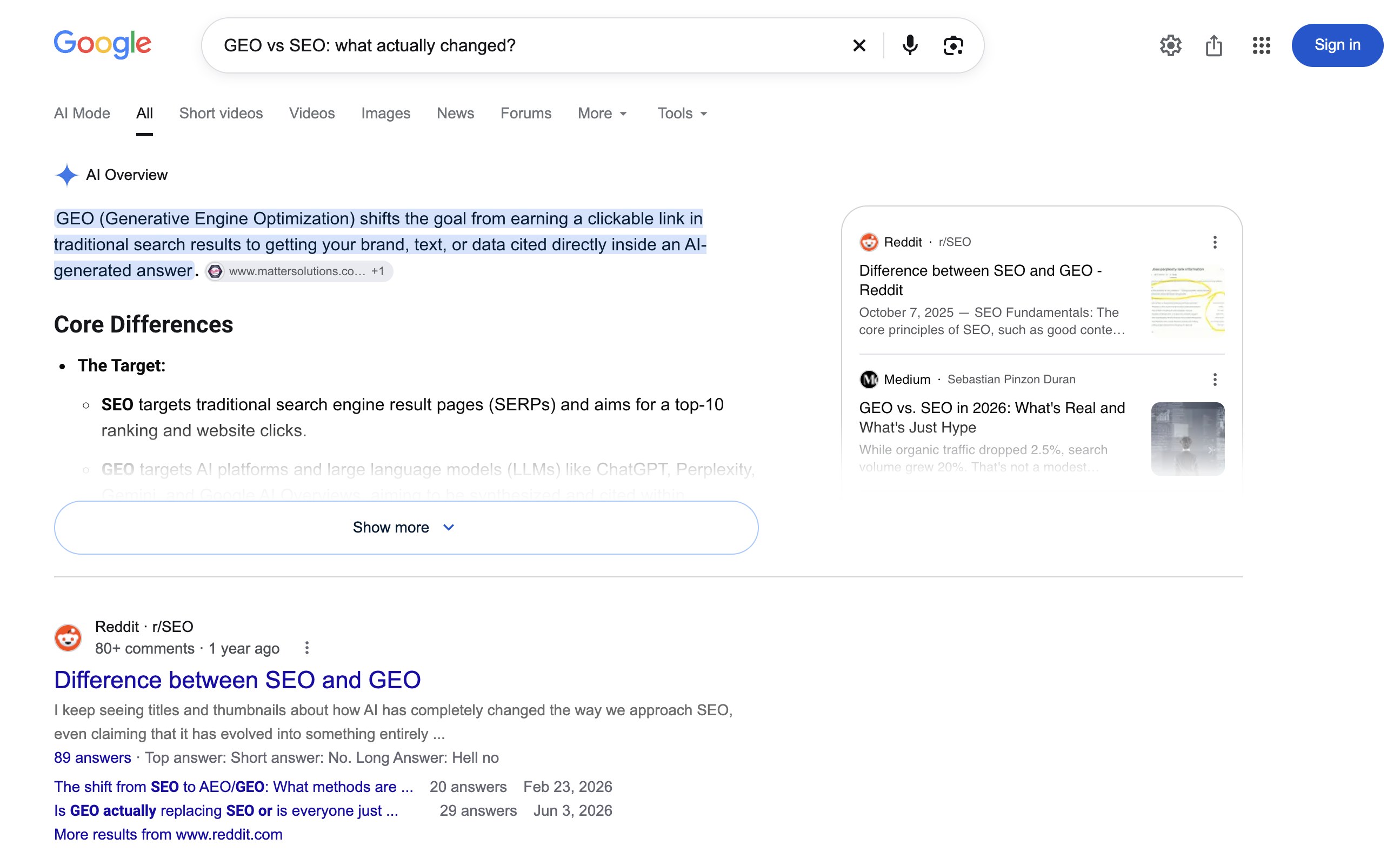
People say "AI search" as if it's one thing. It's at least four.
Google's AI Overview sits on top of Google's own index. ChatGPT, Perplexity and Gemini each run their own search.
Here's how often each cited a site from Google's top 10 for the same question:
| Where I asked | Answers with sources | Cited sites in Google's top 10 |
|---|---|---|
| Google AI Overview | 20 of 20 | 64% (107 of 168) |
| Gemini | 17 of 20 | 16% (11 of 68) |
| ChatGPT | 12 of 20 | 14% (4 of 28) |
| Perplexity | 20 of 20 | 10% (18 of 186) |
Notice Gemini? Google's own chatbot barely followed Google's top 10, about one site in six.
So your rankings still count. They just stop at the edge of Google.
Perplexity sat furthest from Google, so I went back and measured what it picks instead.
Difference 3: how a page gets picked
A ranking is a list of pages for one query. An AI answer is built in two steps: the model searches (often several related questions, a "fan-out"), then writes from the passages it pulled.
That second step changes which page wins. Look at where each one went for sources across my 20 questions:
- Google's top 10 had a Reddit thread for 17 of the 20 questions. The AI Overview cited Reddit on 15, YouTube on 17.
- ChatGPT, Perplexity and Gemini together cited Reddit once.
- ChatGPT went to the source instead: Google's own documentation on 5 questions, OpenAI's docs, and research papers on arXiv. It never cited YouTube, and neither did the other two.
- Perplexity leaned on the big marketing publishers (HubSpot, Semrush, Search Engine Land).
The chatbots skip the forum thread. They go looking for the page that explains the thing first-hand. Be that page.
I traced one later: 14 pages pulled, 3 cited.
Reddit still matters for Google itself, by the way. One chart I posted there passed a million views in a day.
So what makes a passage easy to lift?
- The answer in the first sentence under the heading.
- Real names and numbers in that sentence, with the source linked, so the model can check the claim and quote it whole without guessing what "it" or "above" means.
- One idea per paragraph.
None of it is new. Any good editor would ask you for the same three things.
Difference 4: what you measure
SEO has decades of reporting. GEO has one official report, and it only covers Google.
Since 31 August 2026, every site has Search Console's Generative AI features report. It shows impressions in AI Overviews and AI Mode, by page, country, device and date.
There are no clicks in it and no questions. You'll know a page appeared, and that's all.
For ChatGPT, Perplexity and Gemini, there's no report at all. You read the answers yourself: a fixed list of questions, asked the same way each time, sources logged.
That's the AI visibility check I run for every site I work on.
GA4's referrals from chatgpt.com and perplexity.ai fill in the clicks.
Gemini is the hard one. It seems to have stopped tagging its cited links in late September, and its iPhone app sends no referrer.
So some Gemini visits land in Direct. Check your server logs before you decide Gemini sends nobody.
What stayed the same
More than the GEO hype suggests. Google is blunt about it in its guide to AI features:
"There are no additional requirements to appear in AI Overviews or AI Mode, nor other special optimizations necessary." No AI text files, no special schema.org markup either.
A page still has to be crawlable, indexed and allowed a snippet. The page that answers best still wins.
I check those three, and the AI crawlers, in my own AI SEO audit. Schema still has one job worth doing: saying who you are. What I changed for my own name shows what four assistants say about me now.
One admission. This site ships an llms.txt file anyway, though Google says it doesn't use one. It costs nothing, so it stays.
When I tested 5 Claude SEO skill packs, none of them told me to add one. That was a relief.
What I'd change in an SEO workflow: keep, add, measure
Most of your SEO work stays. This is the list I'd give a team on Monday.
- Keep the technical SEO and the content work. Google and the chatbots read the same pages.
- Keep chasing rankings for questions that show an AI Overview. In my test, the Overview mostly cited pages that already ranked, so rank is still the way in there.
- Add an answer-first sentence under every heading that matters. If someone lifted only that sentence, would it still be right?
- Add first-hand evidence: a number you counted, a screenshot you took. It's what ChatGPT went looking for.
- Add outreach to the pages the answers already cite. Your own page is one source; getting named on theirs is how you show up in the rest. The table below is where to start.
- Measure AI impressions in Search Console every month. Every quarter, ask the chatbots your 10 to 20 most important questions and log which sites they cite. Rank alone won't tell you that.
Outreach: get onto the pages each AI reads
Each tool pulled from a different kind of page in my test. So the outreach is different for each one, too:
| Where the answer came from | What it cited | The outreach that fits |
|---|---|---|
| Google AI Overview | Reddit threads and YouTube videos that rank, plus LinkedIn posts (14 of its 201 links) | Answer in the Reddit thread that already ranks, as yourself, with a number or a screenshot. Make the 5-minute YouTube video that answers the question. Post the finding on LinkedIn |
| ChatGPT | Official docs and research papers: Google's and OpenAI's documentation, arXiv, DOI links | Publish the method and the raw data, and put the dataset on GitHub or Zenodo so it gets a DOI. If you build on a platform, ask to be listed in its partner or integration docs |
| Perplexity | Big marketing publishers: HubSpot, Semrush, Search Engine Land | Pitch the editor one data point for the next update of an article that already ranks. Answer journalist requests on expert-source sites like Qwoted |
| Gemini | "Best tools" roundups. For "What are the best tools for generative engine optimization?", all 6 of its sources were one | Email the author with what's missing from the list and one reason it belongs, plus a login or the data to check it |
The first step is the same for all four. Ask your 10 to 20 questions, open every cited page, and write down who wrote it. That list is your outreach list.
Keep it honest. A Reddit answer that hides who you are gets removed, and an editor can smell a pitch with nothing in it. Bring a number they don't have yet, like the ones in this post.
Some roundups sell their spots. If you pay for one, make sure the page says it's paid.
How I tested it
I asked 20 questions on 26 and 27 October 2026, from a tablet in Bali. Here are the questions, exactly as I typed them.
| # | Question | Group |
|---|---|---|
| 1 | What is generative engine optimization? | Definition |
| 2 | Is GEO replacing SEO? | Definition |
| 3 | What's the difference between GEO, AEO and SEO? | Definition |
| 4 | Is SEO dead now that people use ChatGPT? | Definition |
| 5 | What does GEO mean in SEO? | Definition |
| 6 | GEO vs SEO: what actually changed? | Comparison |
| 7 | Is GEO better than SEO for a small business? | Comparison |
| 8 | Do I need a separate GEO strategy, or is good SEO enough? | Comparison |
| 9 | If my page ranks #1 on Google, will ChatGPT cite it? | Comparison |
| 10 | How do I get my website cited in ChatGPT answers? | How-to |
| 11 | How do I optimize my content for Google AI Overviews? | How-to |
| 12 | Do I need an llms.txt file to show up in AI search? | How-to |
| 13 | Does schema markup help my site appear in AI answers? | How-to |
| 14 | How can I track whether AI tools mention my brand? | How-to |
| 15 | Why is my traffic dropping when my Google rankings haven't changed? | How-to |
| 16 | What does a GEO consultant actually do? | Hiring |
| 17 | How much does generative engine optimization cost? | Hiring |
| 18 | Should I hire an AEO agency or an SEO agency? | Hiring |
| 19 | What are the best tools for generative engine optimization? | Hiring |
| 20 | What should I ask before hiring someone for AI search optimization? | Hiring |
And here's how each tool was set up:
| Where | How I asked | What I counted |
|---|---|---|
| Chrome incognito, signed out, US English | The AI Overview's sources and the top 10 organic results | |
| Gemini | Web app, signed out, fresh browser profile | Every source chip, opened one by one |
| ChatGPT | App, Temporary chat | Cited sources. Its answers still mentioned Bali, so it used the tablet's location |
| Perplexity | App, Incognito Mode | The first screen of sources, up to 10 per answer |
I matched sites, so any page on reddit.com counted as Reddit. By exact URL, about half the AI Overview's sources were in the top 10 (98 of 201).
Each question was asked once, and AI answers change between runs. Take this as a spot check of one weekend.
Why everyone's overlap number is different
My 64% sits well above the big studies. They measured different things, and they get quoted side by side anyway:
| Study | What it counted | Share in Google's top 10 |
|---|---|---|
| Ahrefs, July 2025 | AI Overview citations, 1.9 million | About 76% |
| BrightEdge, data Feb to Jul 2025 | AI Overview sources | About 17% |
| Ahrefs, August 2025 | ChatGPT, Perplexity, Gemini and Copilot citations, 15,000 long-tail prompts | About 12% |
| Ahrefs, March 2026 | AI Overview URLs across 863,000 searches | About 38% |
| My test, October 2026 | AI Overview sites across 20 SEO questions | 64% (49% by exact URL) |
Ahrefs' own number halved in eight months. Their guess: AI Overviews now pull more sources from the related searches Google runs behind the scenes.
Why is mine higher? SEO questions are a small niche where the same big sites hold most of the top 10. And 20 questions is a small sample.
Common Questions
Is generative engine optimization replacing SEO?
No. Google says its AI Overviews need no special optimization beyond normal SEO, and in a 20-question test, more than 60% of the sites AI Overviews cited already ranked in Google's top 10.
What is the difference between GEO and AEO?
Mostly the name. GEO comes from a 2023 Princeton research paper about AI-written answers. AEO, answer engine optimization, is older and grew out of featured snippets and voice assistants. Both now describe getting cited in AI answers.
If my page ranks first on Google, will ChatGPT cite it?
Not reliably. In a 20-question test, only 14% of the sites ChatGPT cited were in Google's top 10. ChatGPT preferred primary sources, like Google's own documentation, OpenAI's docs and research papers.
Do I need an llms.txt file or special schema to show up in AI search?
Google says neither is needed for AI Overviews or AI Mode. A page has to be indexed and eligible for a snippet in Google Search. An llms.txt file is harmless, but Google Search doesn't use it.
How can I see if my website appears in Google's AI Overviews?
Use the Generative AI features report in Google Search Console, open to every site since 31 August 2026. It shows impressions by page, country, device and date, but no clicks and no search queries.
I run real tests on Claude and SEO tools, like 10 voice models on one Mac or 25 audits of a site with 20 planted problems. You get the numbers, including what failed. One email per post, about once a week.
Almost there. Check your inbox and click the link to confirm. Not there in a minute? Look in spam.
Something went wrong on my side. Try again in a minute.
Too many tries. Give it a minute.
That email doesn't look right. Check it for a typo.
Unsubscribe anytime. Privacy