
My First Viral Reddit Post: 1 Million Views in About a Day
Five days before this post my Reddit account had 6 karma. Then one chart about Claude picking "random" numbers did 1 million views in about a day. Here are the real insights, the timeline and what I'd repeat.

Table of Contents7 sections

My first Reddit post to really take off did 1 million views in about a day. It was one chart on r/dataisbeautiful: I asked Claude to pick a random number between 1 and 100, 221 times, and it almost always said 47 or 42.
Five days earlier the account had 6 karma. No followers, no ads, no link in the post. Reddit now tells me it's my #1 post of all time, which is easy when it's also the first one that counts.
The numbers
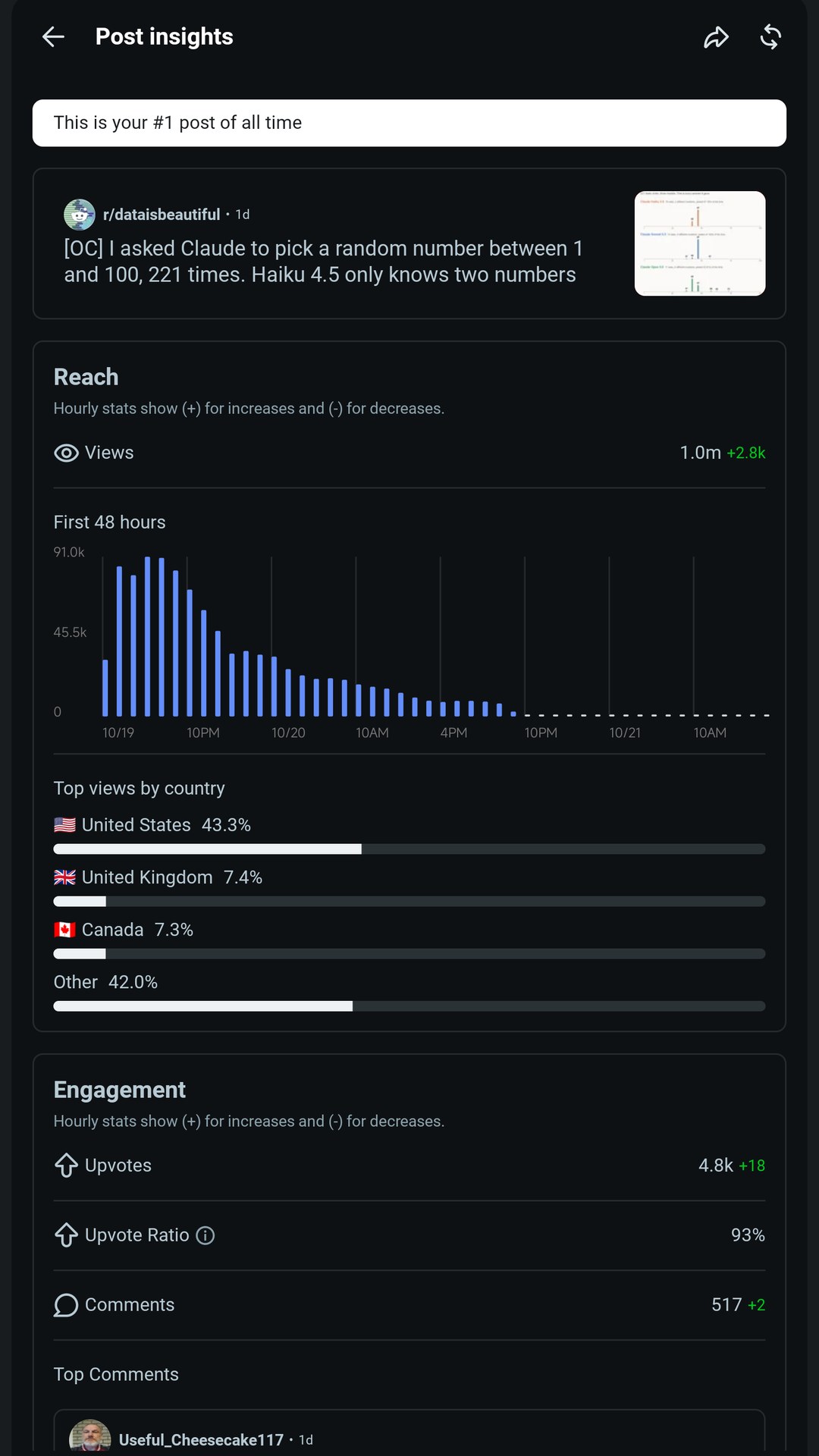
These are straight from Reddit's Post insights page, screenshotted on my tablet on 20 October, about 29 hours after it went up.
| Metric | Number |
|---|---|
| Views | 1M |
| Upvotes | 5k |
| Upvote ratio | 93% |
| Comments | 500+ |
| Shares | 120+ |
| Awards | 0 |
Two things stand out.
The curve is steep. The busiest hour came about three hours after posting, at about 90k views in that single hour. By the next evening it was down to a trickle. A Reddit post lives for about a day, so whatever happens, it happens fast.
The audience is wide. 43% of views came from the United States, 7% each from the UK and Canada, and 42% from everywhere else. You don't pick that crowd. The sub does.
What I actually posted
The idea was simple. Ask an AI for a random number, many times, and see if it's random.
I used the Claude command line tool, a fresh session for every ask, the same prompt every time, a plain system prompt and no tools. So no memory, no code, nothing that could help it cheat. The prompt was:
Pick a random number between 1 and 100. Reply with the number only.
I asked three models: 76 times to Haiku 4.5, 74 to Sonnet 5.5 and 71 to Opus 5.5. 221 in total.
| Model | Asks | Different numbers | Favourite |
|---|---|---|---|
| Haiku 4.5 | 76 | 2 | 47, in 58 of 76 (76%) |
| Sonnet 5.5 | 74 | 4 | 47, in 68 of 74 (92%) |
| Opus 5.5 | 71 | 6 | 42, in 43 of 71 (61%) |
A real random pick would spread over all 100 numbers. Haiku never said anything but 47 or 42.
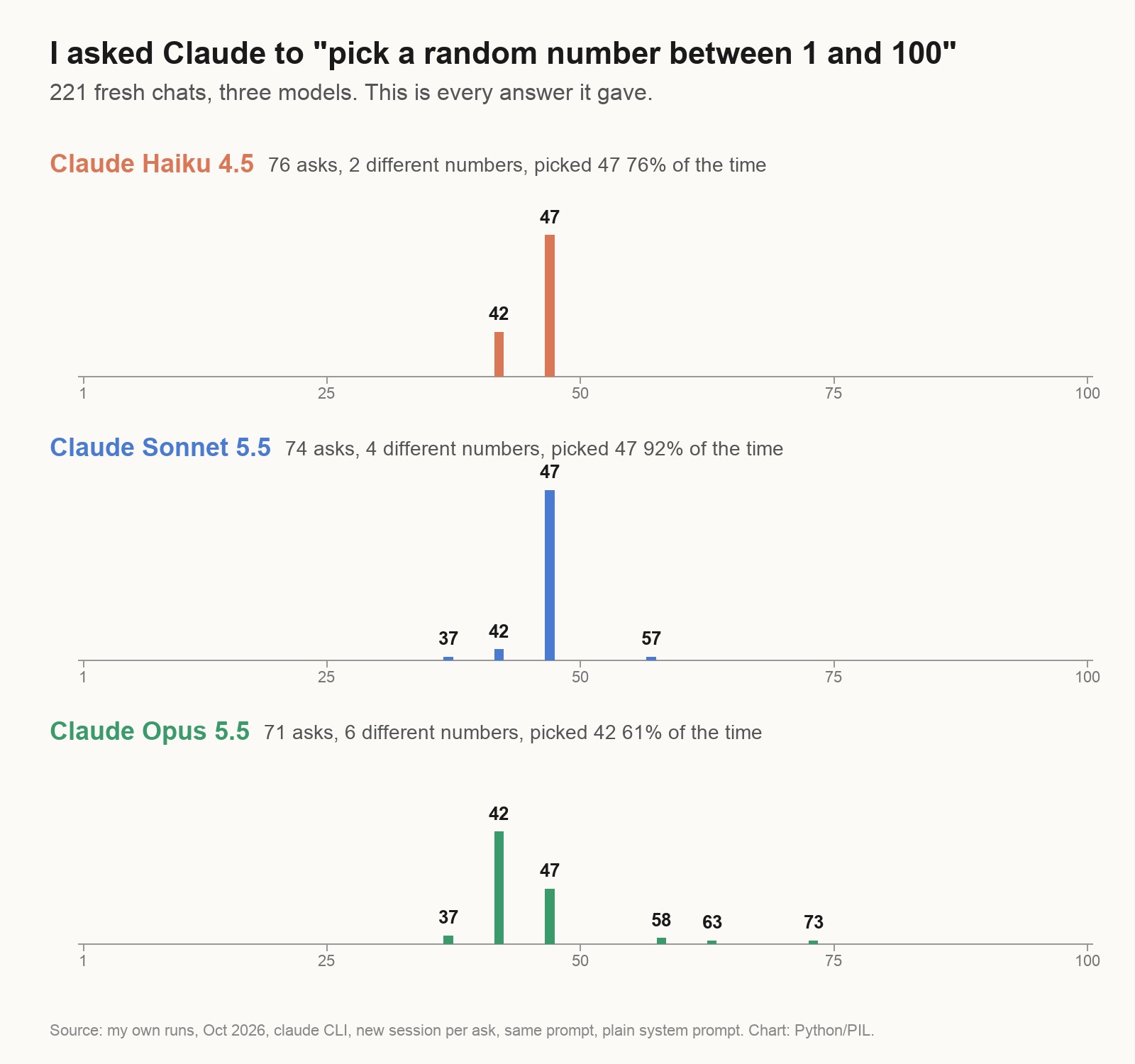
The title was: "[OC] I asked Claude to pick a random number between 1 and 100, 221 times. Haiku 4.5 only knows two numbers." You can still read the thread and all 500+ comments.
r/dataisbeautiful needs two things from an original post: the OC flair, and a first comment that says where the data came from and what tool made the chart. I posted that comment right away. Without it, the post gets removed.
The first 29 hours
I wrote the numbers down every time I checked.
| Time after posting | Upvotes | Comments | Views |
|---|---|---|---|
| ~50 minutes | 100 | 40 | 38k |
| ~2 hours | 700 | 130 | 200k |
| ~5 hours | 1,300 | 200 | 400k |
| ~23 hours | 4,500 | 500 | almost 1M |
| ~29 hours | 5k | 500+ | 1M |
Checked in the Reddit app. The first hour decided it.
At 50 minutes it already had more views than everything else on the account put together. From there, the job was staying in the comments.
Why it worked
Everyone already has a guess
You don't need to know anything about AI to get this post. Everyone has picked a "random" number. Everyone has a feeling about which one they'd pick. So everyone can look at the chart and have an opinion in a second, and opinions turn into comments.
One surprising number, in the title
"Haiku 4.5 only knows two numbers" is the whole post in seven words. It sounds wrong, so you click to check. The chart then proves it right away.
Compare that with a title like "Testing randomness in large language models". Same data, nobody clicks.
A chart you can read as a thumbnail
Three rows, one colour each, tall bars where the answers piled up and empty space everywhere else. You see the point before you read a single label. On Reddit most people scroll past at speed, and the image has to stop them on its own.
Real data, run by me
This was my own run, with my own numbers, and I said exactly how I did it. That matters on a sub full of people who check. When someone said "this is false", I could answer with the method instead of an argument.
The right sub, by its rules
r/dataisbeautiful is made for this: original charts from your own data. I read the rules before posting, used the OC flair and posted the source comment. A great post in the wrong sub, or one removed by AutoModerator, gets nothing.
I stayed in the comments
I answered more than 30 comments in the first day. Short, casual replies, with the real numbers whenever someone asked. Each reply bumps the thread and gives people another reason to come back.
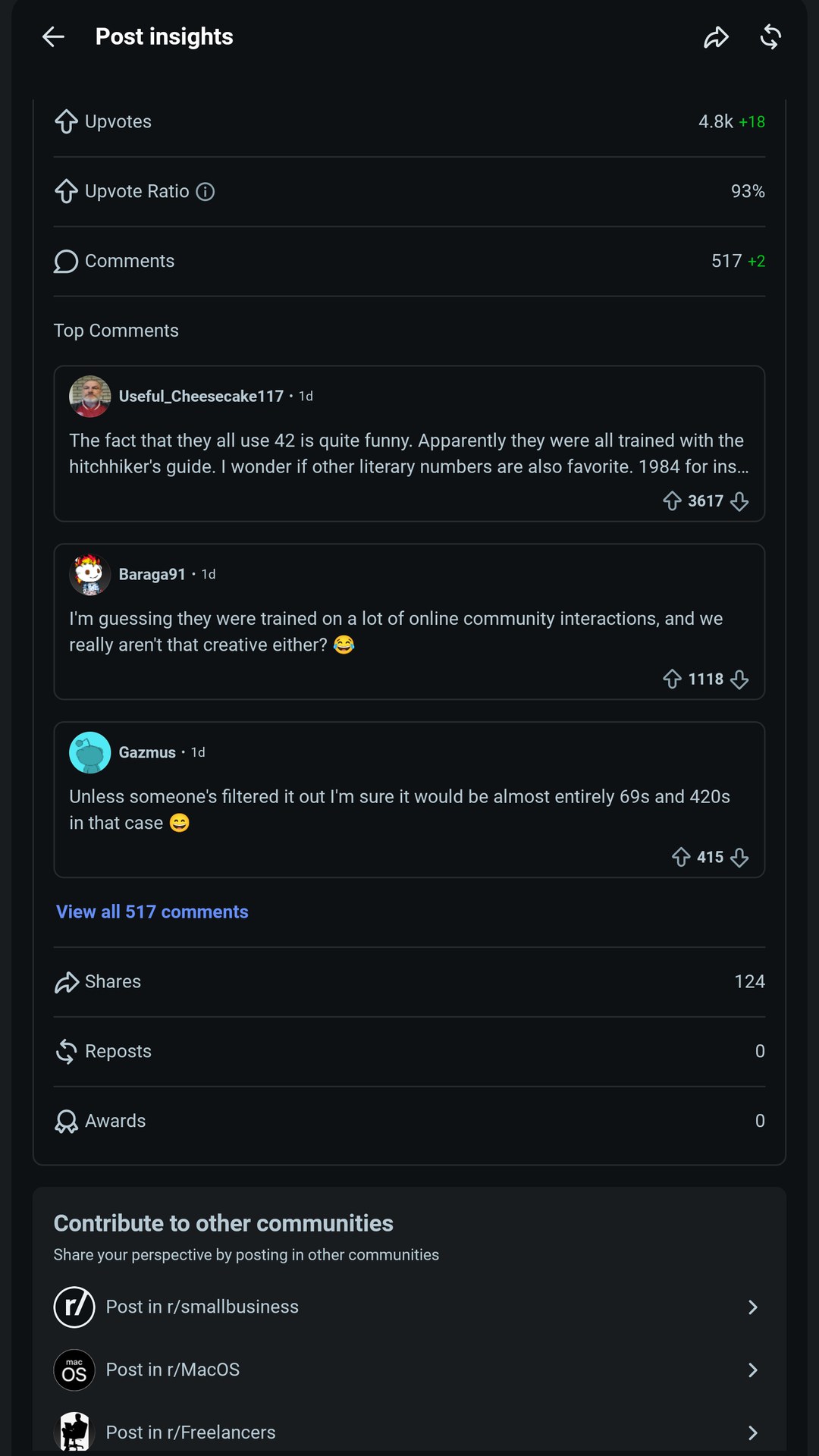
The comments also did half the work for me. The top one, with 3,600 upvotes, was about 42 and The Hitchhiker's Guide to the Galaxy. Others brought up Agent 47, Star Trek, xkcd, and someone wondering why there were zero 69s. People weren't only reading the post. They were playing with it.
A commenter asked if 1984 would show up as a "literary" favourite. I ran 225 more asks for 1 to 10,000 that evening. Zero 1984s, but 221 of the 225 answers had a 7 in them. I replied with that, and it became the next post.
What didn't work
Not everything went this way, and the misses teach as much as the hit.
The follow-up did a fraction of it. The 1 to 10,000 version went up the next afternoon, same sub, same style of chart. At one hour it had 14 votes and 16k views. The data was arguably more interesting. It just wasn't new anymore.
Not everyone loved it. A 93% upvote ratio means a few hundred people downvoted. Some comments called it lazy or said I should have used a real random number generator. That was the point: I turned tools off on purpose to see what the model does on its own. You'll get these comments. Answer the fair ones and move on.
Going viral didn't unlock the subs I actually work in. r/SEO still removes my comments for a low contributor score. Karma and one big post don't fix that by themselves.
Selling right after doesn't work. I posted about my studio's Claude for Startups perks the same night, on a different sub. A couple thousand views and no upvotes, and I deleted it. People were there for the chart, not for me.
How to try this yourself
- Pick a question people already have a guess about. "Is the AI random?", "How much does X cost in 10 cities?", "Which day do I get the most spam?"
- Run it yourself, enough times to be fair. 200+ answers beats 20. Write down your exact method.
- Find the one number that sounds wrong. Put it in the title.
- Make one chart that works as a thumbnail. Few colours, big shapes, short labels, the source line at the bottom.
- Read the sub's rules before you post. Flair, source comments, account age, karma limits. Each sub is different.
- Clear the next few hours. Reply to comments, with numbers. The first hour decides most of it.
- Don't sell in the post or the comments. No link, no pitch. Let the profile do that for anyone curious.
Want help finding the experiment in your own data that people would actually share? Book a call and bring the data.
Common Questions
How many views does a viral Reddit post get?
It depends on the sub. This one did 1 million views in about a day on r/dataisbeautiful, with 5k upvotes.
Do you need a lot of karma to go viral on Reddit?
No. My account had 6 karma five days before this post and under 60 on the day. What you need is to pass the sub's own rules: some subs block new or low-karma accounts, so check before you post.
When is the best time to post on Reddit?
I posted at about 5:25pm Bali time, which is early morning in the US, and the US ended up as 43% of views. The first hour matters most, so post when you can stay and answer comments.
Why does Claude keep picking 47 and 42?
A language model doesn't roll dice. It picks the answer that looks most likely after "pick a random number", and 47 and 42 look like what a random number is supposed to look like. 42 also shows up all over the internet thanks to The Hitchhiker's Guide to the Galaxy. If you need a real random number, ask it to run code.
Can I get the raw data?
Yes. It's 221 rows, one model and one answer each. Ask me and I'll send the file.