10 Best Free ElevenLabs Alternatives to Start a YouTube Channel for 2027
ElevenLabs charges for cloning and a commercial license. I ran 10 free voice models on my own Mac with the same paragraph, timed them, had a speech-to-text model check every word, and read every license. Here's what I'd use, and what you can't monetize.

Table of Contents8 sections
Get my next blog post first
Real tests on Claude and SEO tools, with the numbers and what failed. About once a week.
Unsubscribe anytime. Privacy

I was watching a video on YouTube about the history of Japan, and suddenly thought about starting my own channel. I'd need a narrator.
Btw the video is really simple and still very satisfying, because I always wanted to know about Japan and samurai.
ElevenLabs was the obvious pick, until I read the pricing page. Cloning a voice and using the audio commercially both start on paid plans: $6/month for Starter, $22/month for Creator.
Could a free model do the job going into 2027? In late October 2026 I tried 10 open-source voice models on my M4 Mac with 16 GB, all reading one paragraph about Japan in 1600.
I timed each one, had a speech-to-text model check every word, and then read every license, because that's the part most "free alternative" lists skip.
The short version: Chatterbox Multilingual is the free ElevenLabs alternative I'd use. It cloned a voice from a 12 second clip, and its MIT license lets you monetize.
It's not the fastest. But it said "shoguns" right, where three quicker models said "show guns".
Nobody paid me for this, and there's no affiliate link on this page. So judge the voices yourself: every sample is below.
Each model below has a sample you can play, all reading the same script. The full ranking comes at the end, once you've heard them.
Key Takeaways
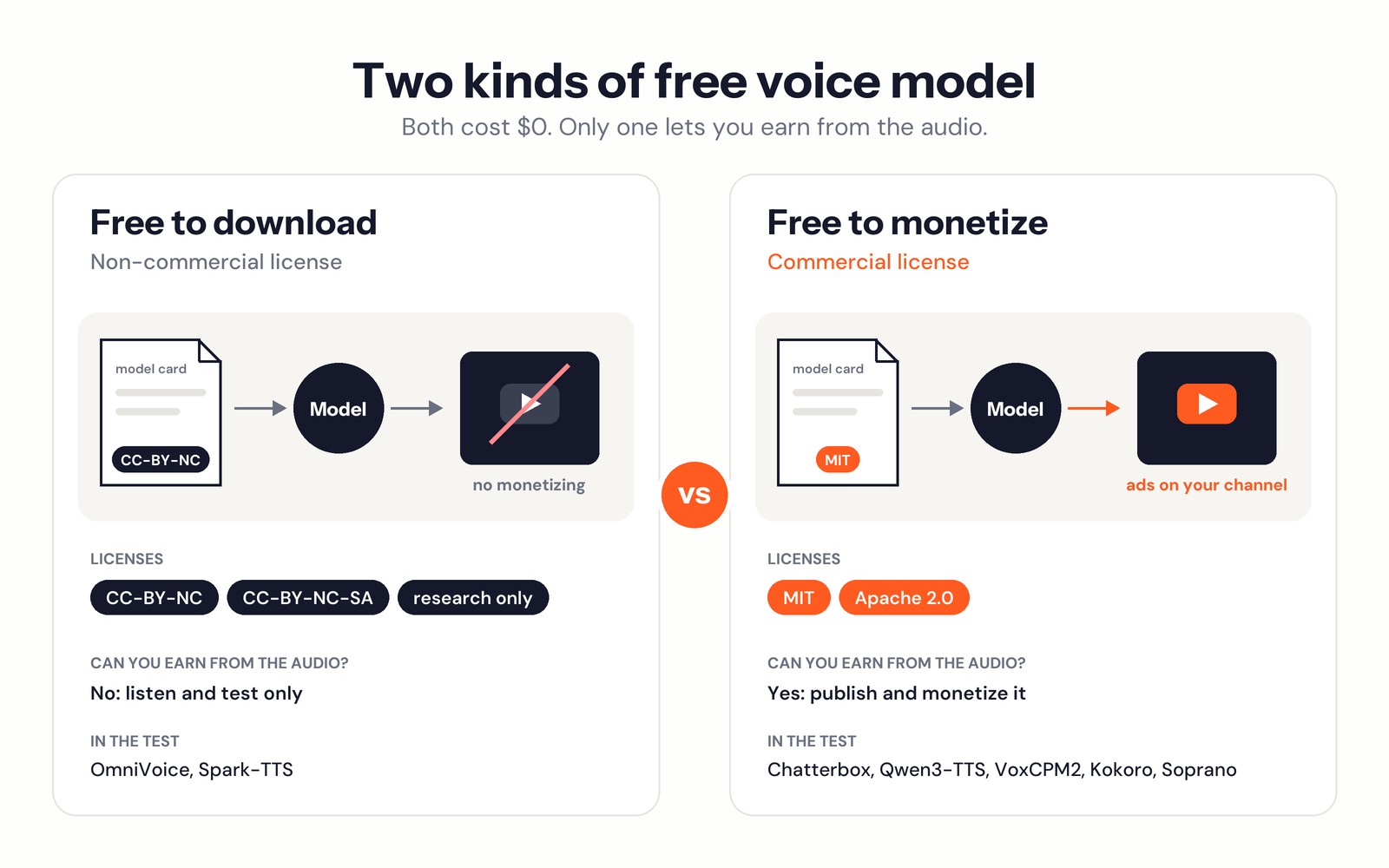
- Free has four meanings: a free plan, a free app, free model weights, and free for commercial use. Only the last one lets you put the audio on a monetized channel.
- Chatterbox Turbo, Kokoro and Qwen3-TTS are free to use commercially and ran fine on a 16 GB Mac. Chatterbox and Qwen3 clone a voice from a short clip.
- Several popular picks are non-commercial: OmniVoice, F5-TTS, XTTS-v2, Spark-TTS, Voxtral and Fish Audio S2 Pro. You can test with them, but you can't sell what they make.
- Free models still lose on long scripts. The voice drifts a little from one sentence to the next, so generate in short chunks.
What "free" means for an ElevenLabs alternative
Most lists put four different things under one word. If you want to earn from the audio, only one of them counts.
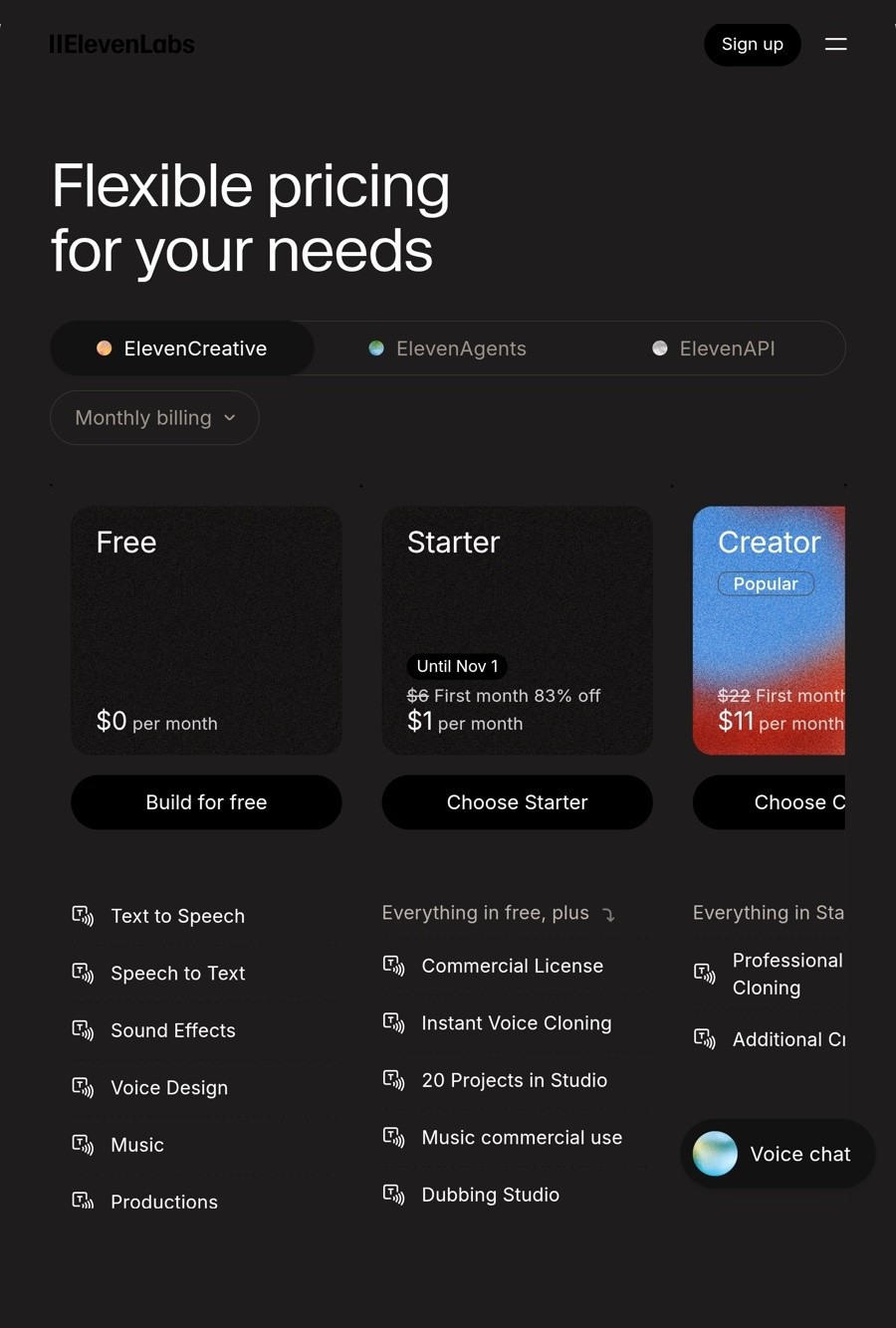
- A free plan. ElevenLabs Free gives you 10,000 credits a month, with no commercial license and no cloning.
- A free app. Voicebox is free and MIT-licensed, but that's the app. Each of its 8 voice engines has its own license, and TADA's comes with Meta's Llama terms.
- Free weights. You can download them and run them at home. What you're allowed to do with the audio is a separate question.
- Free for commercial use. The model's own license, MIT or Apache 2.0 here, lets you publish and monetize what it makes. That's the one a YouTube channel needs.
That's what the paid plans sell. Starter adds the commercial license and instant cloning, and Creator adds professional cloning.
I read the ElevenLabs pricing page on October 26, 2026, and Starter was $1 for the first month until November 1.
Check yours before you pay.
Check the license on the model card, not the app
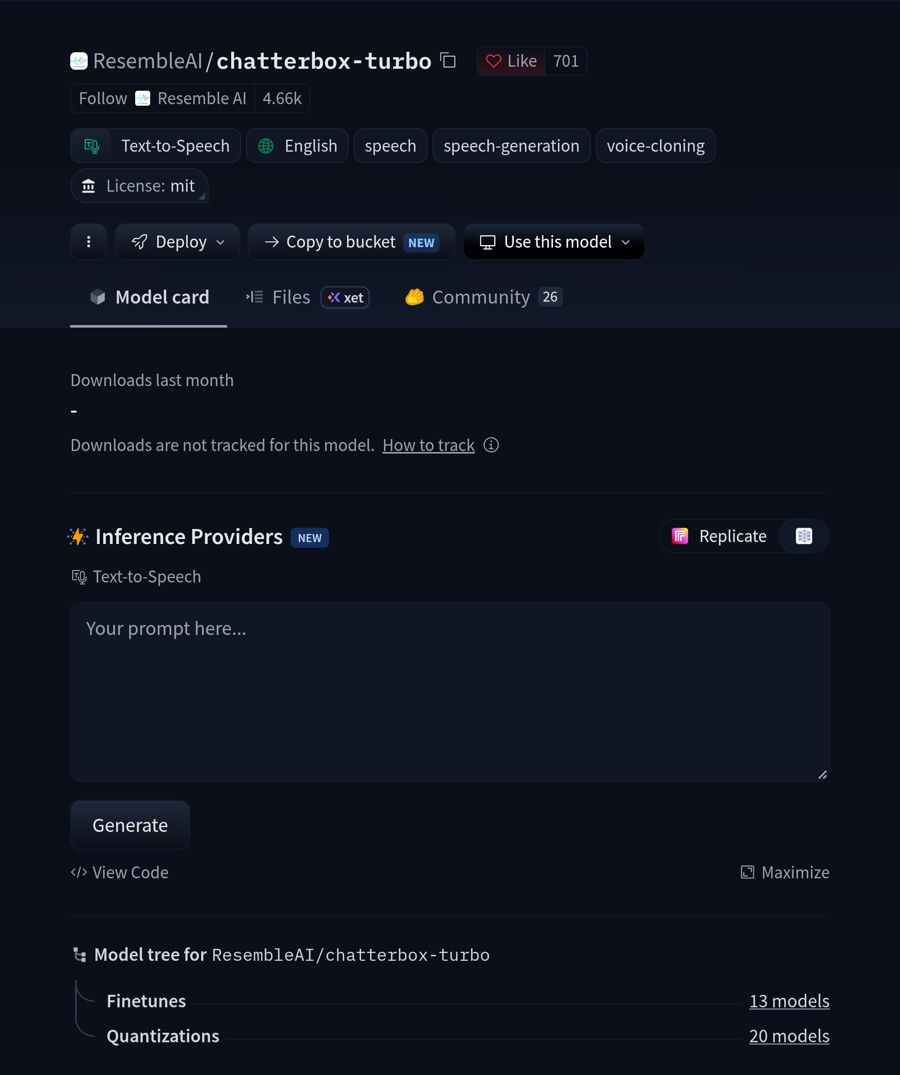
The license sits on the model's Hugging Face page, usually as a tag near the top. Read it for the exact model you run, because the code and the weights can carry different licenses.

OmniVoice is the clearest case I found. Its code is Apache 2.0, but the model itself is CC‑BY‑NC because of what it was trained on (the Emilia dataset).
So an app that bundles it can look fully open source, and you still can't monetize the audio it makes.
How I tested them on an M4 Mac
I wanted a test you could repeat in an afternoon, so every model got the same job.
- One Mac. My MacBook with an M4 and 16 GB, on macOS 26.
- One library. mlx-audio runs all of these on Apple Silicon, each from its
mlx-communitycopy on Hugging Face. - One script, about 60 words on Japan in 1600, with a date, a Japanese name and a list.
- One voice to copy. The same 12 second clip went to every model that clones. Kokoro read with a preset voice, Soprano with its default, and Qwen3 VoiceDesign got a description: "a calm, warm male documentary narrator in his forties".
- Timing. A first run to download and load the model, then a timed one. So the times in the table leave out the download.
- A word check. A speech-to-text model, Parakeet, wrote down each sample, and I counted the words that didn't match.
Here's the paragraph every model read:
In 1600, at the Battle of Sekigahara, Tokugawa Ieyasu defeated his rivals and took control of Japan. His family would rule for more than 250 years. To keep that power, the shoguns closed the country to almost all foreigners, and for two centuries Japan looked inward, building a culture of tea houses, woodblock prints, and strict social order.
The voice they copied isn't mine. It's Kokoro's am_michael preset, so every model chased the same clean voice, and you can hear how close each one gets. Here it is:
The clip is about the black ships of 1853, not the script, so what you hear later is each model's own read.
Two models needed a fix before they'd run. Kokoro looked for its espeak-ng data in a folder on someone else's build machine. Installing espeak-ng with Homebrew sorted it.
Spark-TTS needed a missing Python package, then a 15-line patch so mlx-audio loads it properly. My first word checker, Whisper, wouldn't load at all, so Parakeet took over.
I ran the first four models twice, and the times moved by about 10%. The Mac also lagged while the big ones ran (close your other apps first).
The best free ElevenLabs alternatives, tested
Every sample below reads the Sekigahara paragraph. The six you can monetize come first, then the two I tested but can't recommend.
 Chatterbox Turbo: fast, but it slips on words
Resemble AI built Turbo as a lighter Chatterbox, 350M parameters. It made 25 seconds of narration in about 25 seconds, using about 3 GB.
One catch: every file carries Resemble's Perth watermark, which you can't hear but Resemble's own script can detect.
On a YouTube channel that's harmless, but you should know it's in your audio.
The slip I only caught by ear: Turbo says "shoguns" as "show guns". For a history channel, you'd fix that word by hand.
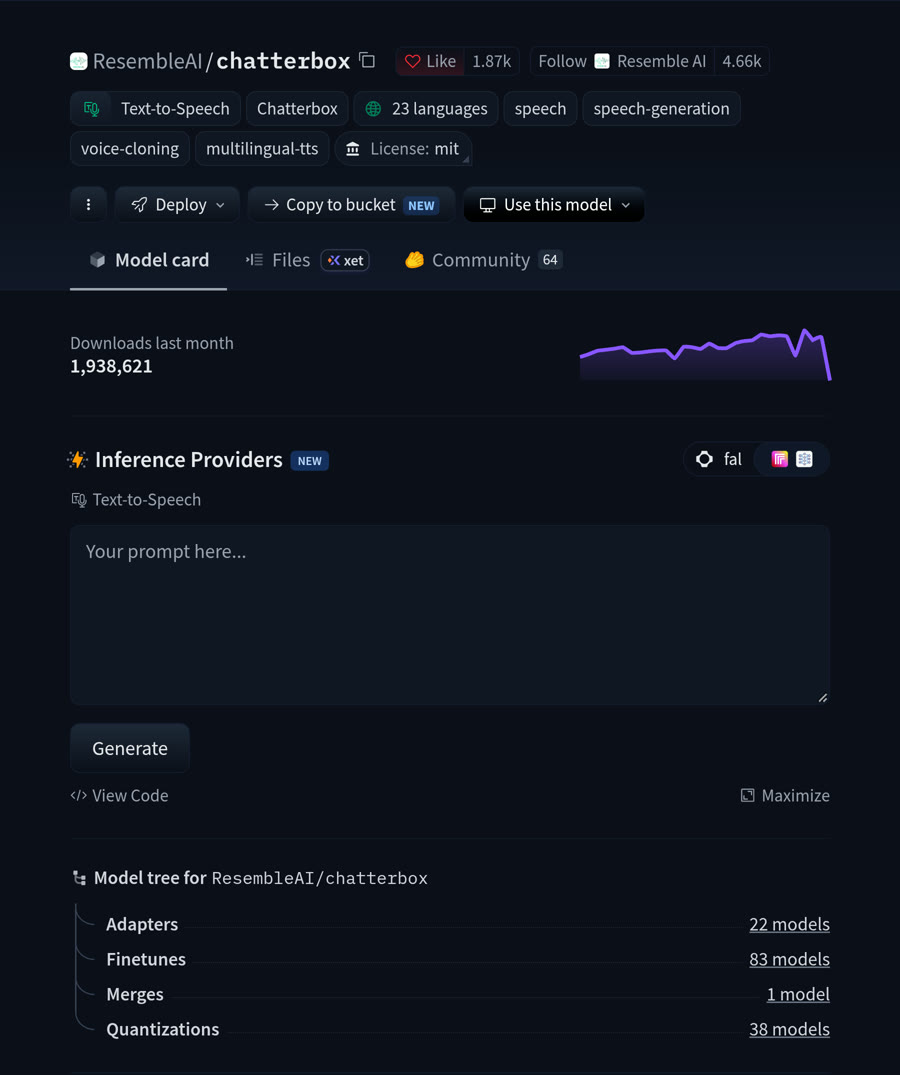
Chatterbox Multilingual: the free voice clone I'd use
This is the original Chatterbox, bigger (500M), MIT too, and in 23 languages. It took about 40 seconds where Turbo took 25, but it says "shoguns" right where Turbo doesn't.
A narrator has to get almost every word right, so I'll take the slower one.
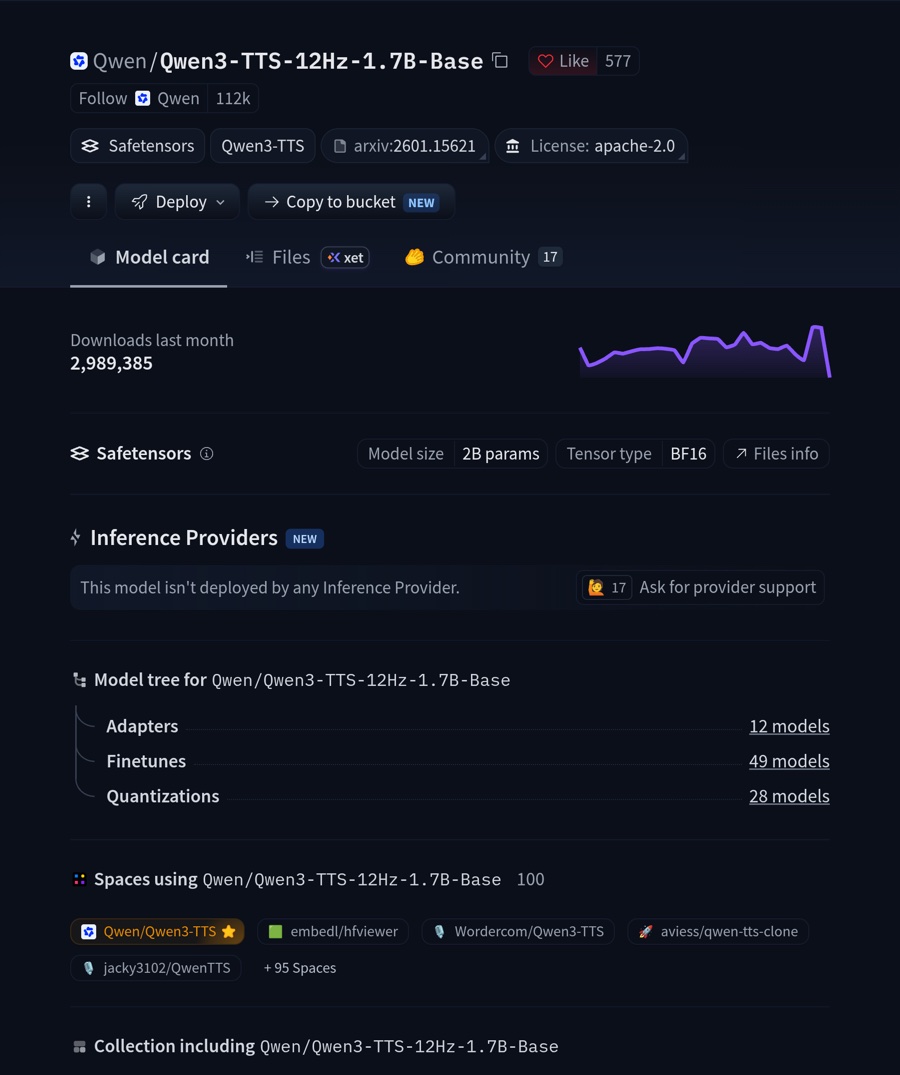
 Qwen3-TTS: clone a voice, or describe one
Alibaba's Qwen team ships these under Apache 2.0, in 10 languages (Japanese is one). The 0.6B tied with Turbo on every number I measured.
The Base models clone. VoiceDesign needs no clip: you describe a voice in a sentence, and it makes one.
The 1.7B Base read fastest of all, about 20 seconds of audio for the same words.
Both cloned Qwen3 voices say "show guns" too, the same slip as Turbo.
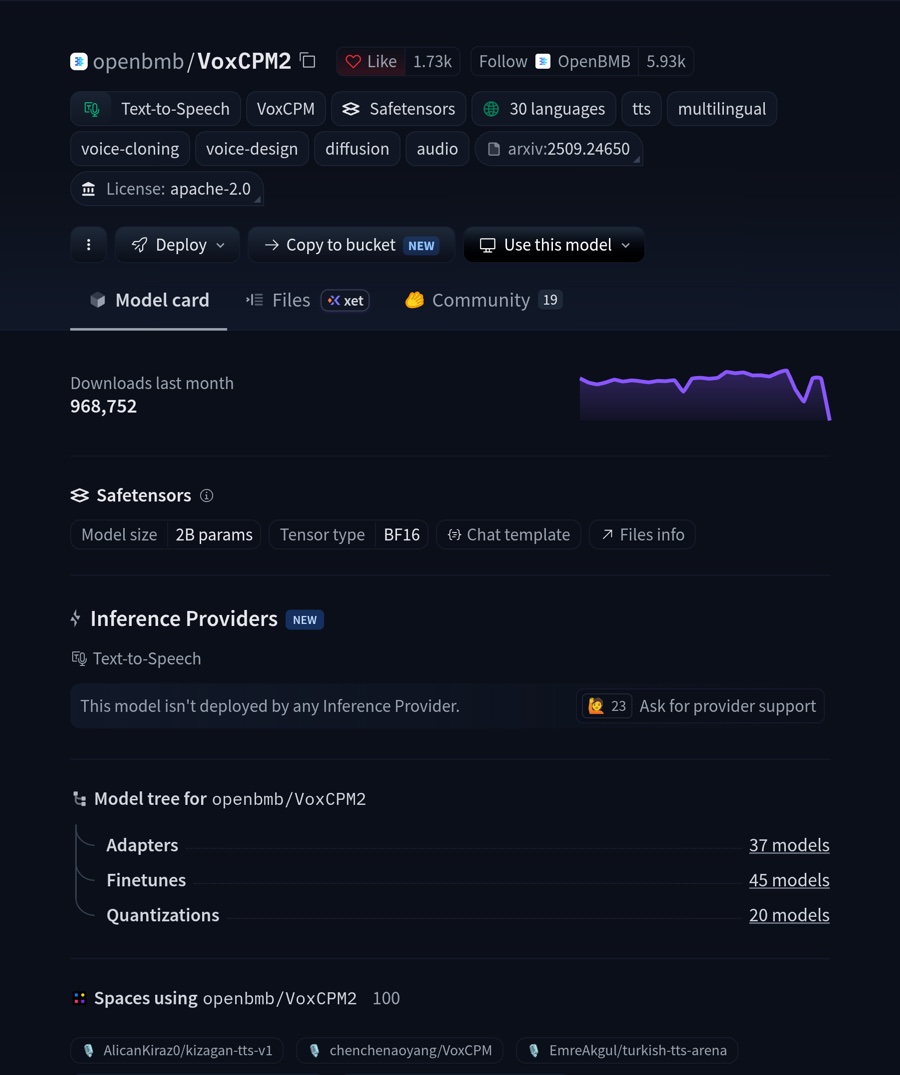
 VoxCPM2: the biggest, and the slowest
OpenBMB's VoxCPM2 has 2 billion parameters, 30 languages and 48 kHz audio. It can design a voice from a description too.
On my 16 GB Mac it was the slowest by far: about 80 seconds for 23 seconds of audio, with 5 GB in use.
If you render your script overnight, you won't care about the wait, and you get the highest sample rate of the ten.
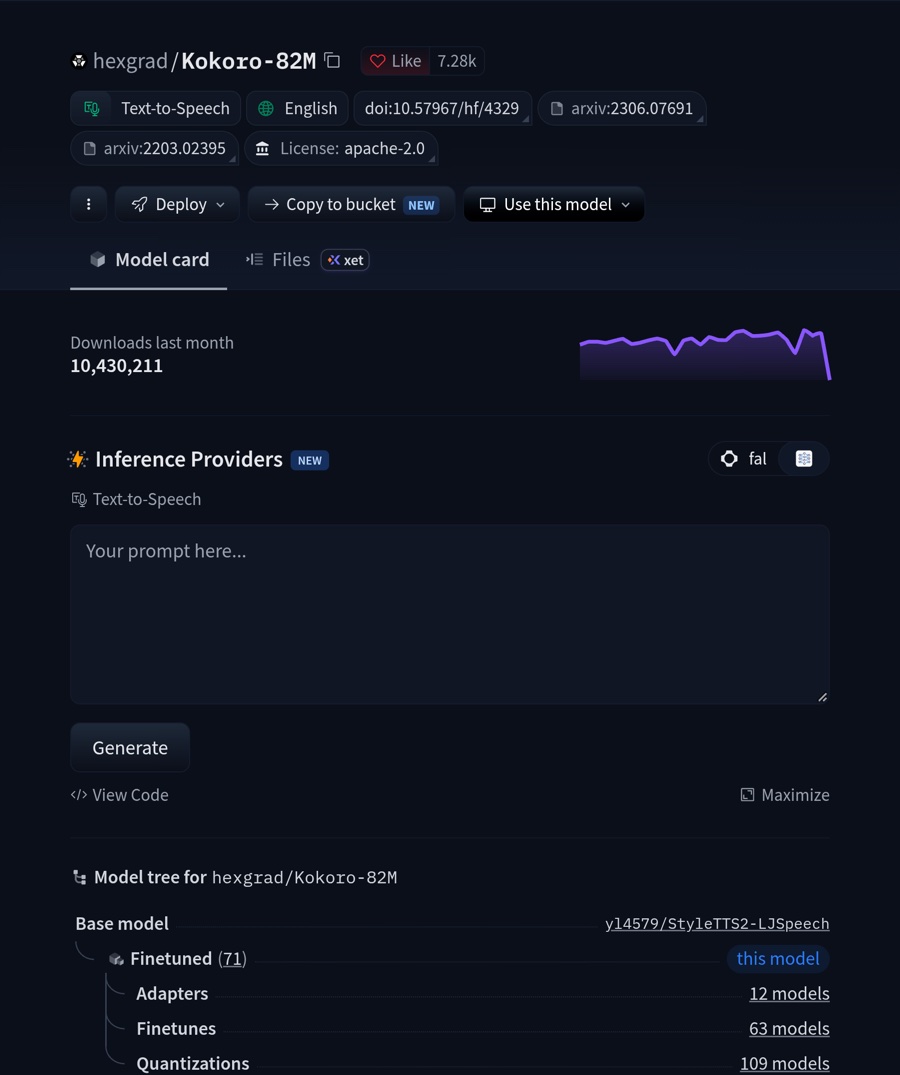
 Kokoro-82M: the fastest, but no cloning
- 54 preset voices in 8 languages. The one I used, am_michael, is also the clip the others copied.
- About 8 seconds for 25 seconds of audio, in under 1 GB.
- No cloning, no emotion control. One Reddit user called it "bottom of the barrel" for exactly that.
If you want to draft a whole script and hear how it flows before you pick a voice, nothing here is quicker.
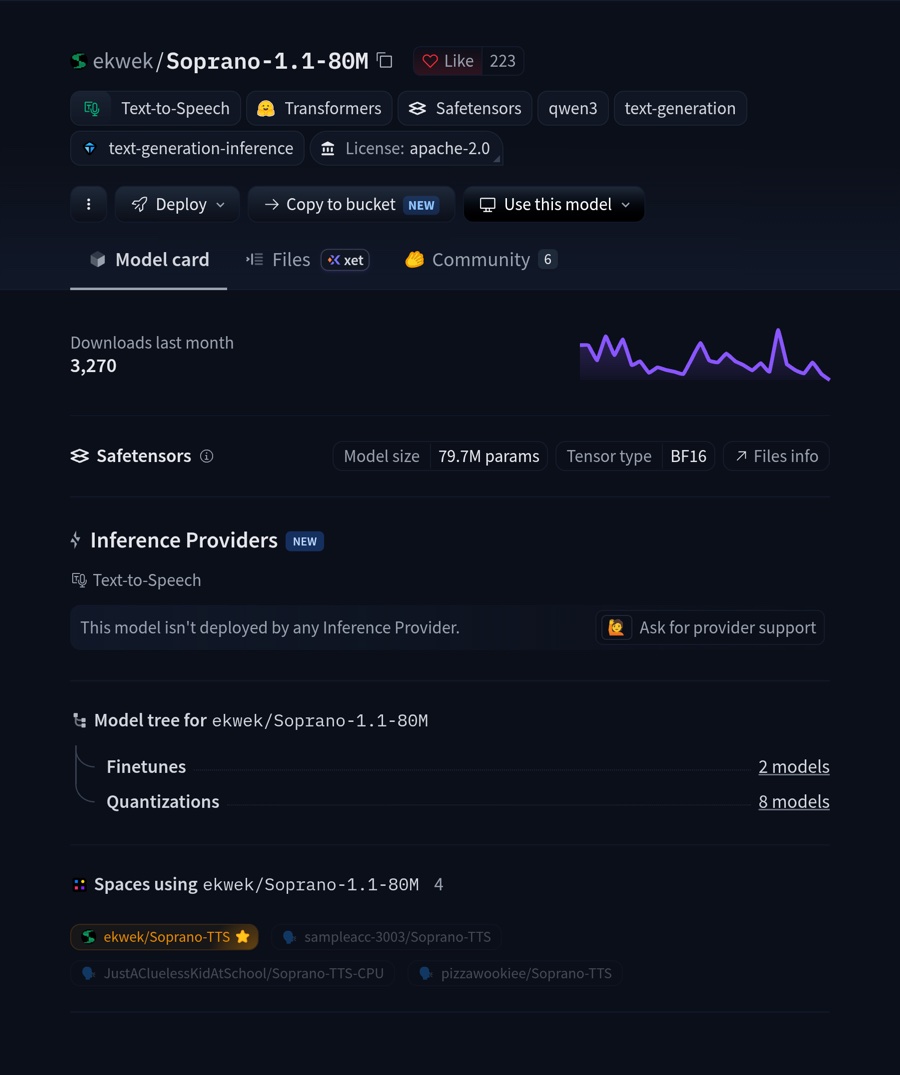
 Soprano 1.1: as fast as Kokoro, English only
Soprano is even smaller (80M) and matched Kokoro at about 8 seconds. Its own model card lists the limits: English only, no cloning, and only about 1,000 hours of training audio.
So rare words can slip on you, and Parakeet heard its Ieyasu as "Ayasu".
Honestly, I couldn't even finish listening to the output :D
Good, but not for a monetized channel
These come up in every Reddit thread, but their licenses rule out commercial use:
| Model | License | Why people pick it |
|---|---|---|
| OmniVoice | CC‑BY‑NC (weights) | Strong cloning in many languages |
| Spark-TTS 0.5B | CC‑BY‑NC‑SA | Small, and it clones |
| F5-TTS | CC‑BY‑NC (weights) | A popular cloner on Apple Silicon |
| XTTS-v2 | Coqui's non-commercial license | The old favorite; Coqui has shut down |
| Fish Audio S2 Pro | Fish Audio research license | Recommended a lot on Reddit |
| Voxtral TTS | CC‑BY‑NC | Mistral's voice model |
| IndexTTS-2 | bilibili's own license | Read the terms before any commercial use |
I ran OmniVoice and Spark-TTS, so you can hear what you'd be giving up. The rest I skipped, because their license had already ruled them out for you.
Where free still loses to ElevenLabs
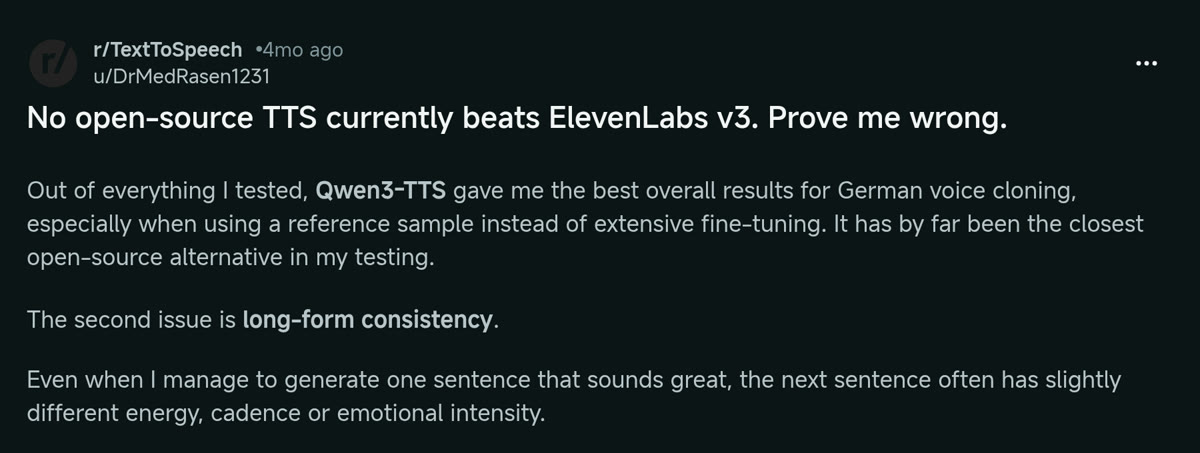
Long scripts are the real gap. One Reddit tester cloned German voices with every open model they could find and rated Qwen3-TTS the best. But the next sentence often came out with different energy.
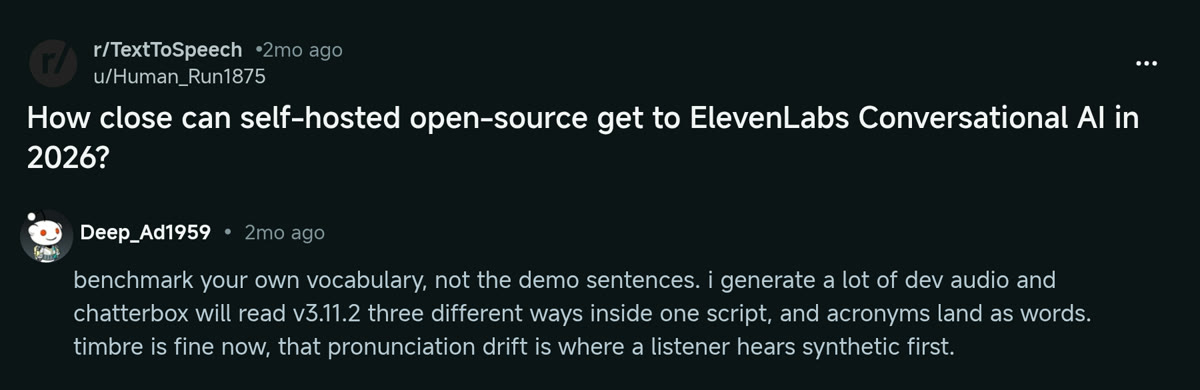
Words drift too. Someone who generates a lot of developer audio found Chatterbox reading one version number three different ways in a single script. That's my "show guns" problem, in another field.
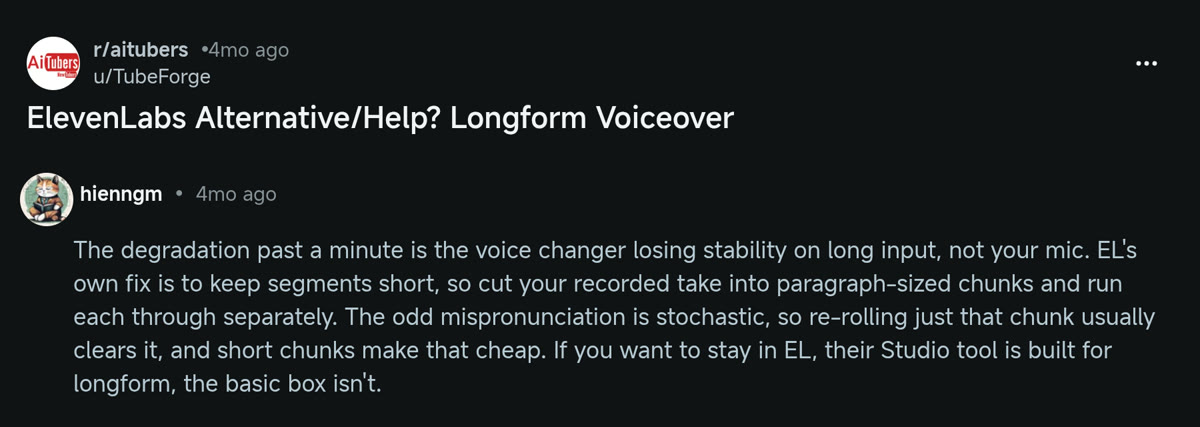
The fix I'd use: generate one paragraph at a time, listen, and redo only the paragraph that came out wrong. A reply in r/aitubers gives the same advice for ElevenLabs itself.
Worried an AI voice gets your channel demonetized? YouTube's monetization policies go after repetitive, mass-produced videos, not AI voices as such. Your own research, script and edit count for more than whose voice reads it.
Run the same test yourself
On an Apple Silicon Mac with Homebrew and uv, this clones your voice with my pick:
uv venv --python 3.12 tts && source tts/bin/activate
uv pip install mlx-audio "misaki[en]"
brew install espeak-ng
export ESPEAK_DATA_PATH=/opt/homebrew/share/espeak-ng-data
export PHONEMIZER_ESPEAK_LIBRARY=/opt/homebrew/lib/libespeak-ng.dylib
mlx_audio.tts.generate --model mlx-community/chatterbox-multilingual-v3 \
  --ref_audio my-voice.wav --text "Your script here." --output_path out
The two export lines are the espeak-ng fix from earlier; only Kokoro needs them. Swap the model name for any other row, like mlx-community/chatterbox-turbo-fp16.
And test with your own script, not a demo sentence. Names, dates and words like "shogun" are where these models slip.
I write every post on this blog with Claude Code, and it ran this whole test for me. If you want your AI writing to sound like you too, here's the voice file I use. I ran the same kind of side-by-side test on Claude SEO skills.
Best free ElevenLabs alternatives: the verdict table
The table's ranked for a YouTube narrator. "Words wrong" is how many words Parakeet heard differently from the script.
| # | Model | Clones a voice? | Commercial use? | Time | Audio | Memory | Words wrong |
|---|---|---|---|---|---|---|---|
| 1 | Chatterbox Multilingual | Yes, 23 languages | Yes, MIT | 40 s | 23 s | 3 GB | 1 |
| 2 | Chatterbox Turbo | Yes | Yes, MIT | 25 s | 25 s | 3 GB | 1 |
| 3 | Qwen3-TTS 0.6B | Yes | Yes, Apache 2.0 | 27 s | 23 s | 3 GB | 1 |
| 4 | Qwen3-TTS 1.7B VoiceDesign | From a text description | Yes, Apache 2.0 | 38 s | 28 s | 3.5 GB | 0 |
| 5 | Qwen3-TTS 1.7B | Yes | Yes, Apache 2.0 | 35 s | 20 s | 4.5 GB | 1 |
| 6 | VoxCPM2 | Yes | Yes, Apache 2.0 | 80 s | 23 s | 5 GB | 2 |
| 7 | Kokoro-82M | No, preset voices | Yes, Apache 2.0 | 8 s | 25 s | < 1 GB | 1 |
| 8 | Soprano 1.1 | No | Yes, Apache 2.0 | 8 s | 20 s | < 1 GB | 1 |
| 9 |  OmniVoice | Yes | No, CC‑BY‑NC | 34 s | 26 s | 2 GB | 0 |
| 10 |  Spark-TTS | Yes | No, CC‑BY‑NC‑SA | 30 s | 26 s | 3 GB | 3 |
Chatterbox Multilingual is my pick, even though it's the slowest of the top four, because it suits my ear. Turbo and Qwen3-TTS 0.6B tie on the numbers, both about as fast as the audio runs.
But both said "show guns", and the Multilingual model didn't. For a history channel, a wrong word costs more than 15 seconds.
The word check didn't separate them. No model got more than 3 words wrong, and nearly every slip was the name Ieyasu (which the checker may mishear on its own).
It can't hear a bad pronunciation, though. Parakeet wrote "shoguns" for Turbo and both Qwen3 clones, and my ears heard "show guns" from all three. So listen to your own script before you publish.
So I ranked them on four things, in this order. Can you earn from the audio? Does it say the words right? Can it give you a voice of your own? And how fast does it run on your Mac?
OmniVoice and Spark-TTS sit at the bottom for one reason: you can't monetize what they make, however good they sound.
Which one should you use?
- A monetized channel in your own voice: Chatterbox Multilingual. Record a clean clip about as long as my 12 second one, and clone it.
- Drafting fast: Kokoro, or Turbo if you want your own voice. Then fix the words they get wrong.
- A voice that doesn't exist yet: Qwen3-TTS VoiceDesign. Describe it in a sentence.
- A channel in another language: Chatterbox Multilingual again (23 languages), or Qwen3-TTS (10).
- No terminal at all: a desktop app like Voicebox runs Chatterbox, Qwen3-TTS and Kokoro with buttons. Check which engine you picked, then check that engine's license.
Common Questions
What is the best free ElevenLabs alternative for a YouTube channel in 2027?
Chatterbox Multilingual, in my test. It's free, MIT licensed so you can monetize the audio, cloned a voice from a 12 second clip, and said "shoguns" right where faster models said "show guns".
Is there a free, open-source alternative to ElevenLabs on GitHub or Hugging Face?
Yes, several. Chatterbox, Kokoro, Qwen3-TTS and VoxCPM2 are open source and free for commercial use under MIT or Apache 2.0. On an Apple Silicon Mac, mlx-audio runs all four offline.
Can I run an ElevenLabs alternative locally on a MacBook with 16 GB of memory?
Yes. A 16 GB M4 MacBook ran all ten models in my test through mlx-audio. The biggest, VoxCPM2, used about 5 GB of memory and took about 80 seconds for 23 seconds of audio.
What is the best free AI voice cloning model I can use commercially?
Chatterbox Multilingual. It's MIT licensed and cloned a 12 second clip without the "show guns" slip that Chatterbox Turbo and Qwen3-TTS made. OmniVoice and Spark-TTS clone well too, but their licenses are non-commercial.
Can I clone my voice with ElevenLabs for free?
No. On October 26, 2026, the ElevenLabs free plan had no voice cloning and no commercial license. Instant cloning started on the Starter plan at $6/month. A local model like Chatterbox clones a voice for free.
Can I use a free AI voice on a monetized YouTube channel?
Yes, if the model's license allows commercial use, like MIT or Apache 2.0. YouTube's monetization policies target repetitive, mass-produced videos, not AI voices as such. Avoid non-commercial models like OmniVoice, F5-TTS and XTTS-v2.
Do free text-to-speech models pronounce names and history words correctly?
Not always. In my test, Chatterbox Turbo and both Qwen3-TTS clones said "shoguns" as "show guns", and most models slipped on the name Ieyasu. Generate one paragraph at a time and redo the ones that come out wrong.
Want my next blog post before anyone else?
I run real tests on Claude and SEO tools, like 10 voice models on one Mac or 25 audits of a site with 20 planted problems. You get the numbers, including what failed. One email per post, about once a week.
Unsubscribe anytime. Privacy