
How I Stop Claude From Writing AI Slop (My Voice File)
The same week Claude helped me make a Reddit post with 1 million views, it wrote replies I sent back as "sound ai". Here are the drafts, the humanizer that failed, my voice file and the free dictation app it's built from.

Table of Contents10 sections

On 19 October a Reddit post I made with Claude did 1 million views in about a day. Claude ran the test, drew the chart and wrote the title.
Three days earlier, the same Claude wrote me Reddit replies that I sent straight back. My whole note was two words: "sound ai".
The short version: AI slop isn't about which model writes. It's what's missing: a real moment, your own numbers, an opinion you'd defend.
I give Claude those through a voice file. It's built from my own edits and from 566 prompts I said out loud into FluidVoice, a free dictation app.
You can find a hundred lists of words to ban. This one is my own drafts: the ones that failed, the ones that went out, and what changed in between.
Want my voice file? It's free at the end of the post. Only here for the setup? Skip to build your own voice file, five steps.
The Same Claude, Two Different Results
The 1 million view post was Claude's work nearly end to end. It ran 221 fresh sessions asking for a random number, drew the chart and drafted the title I posted. I picked the idea and the sub, and said yes.
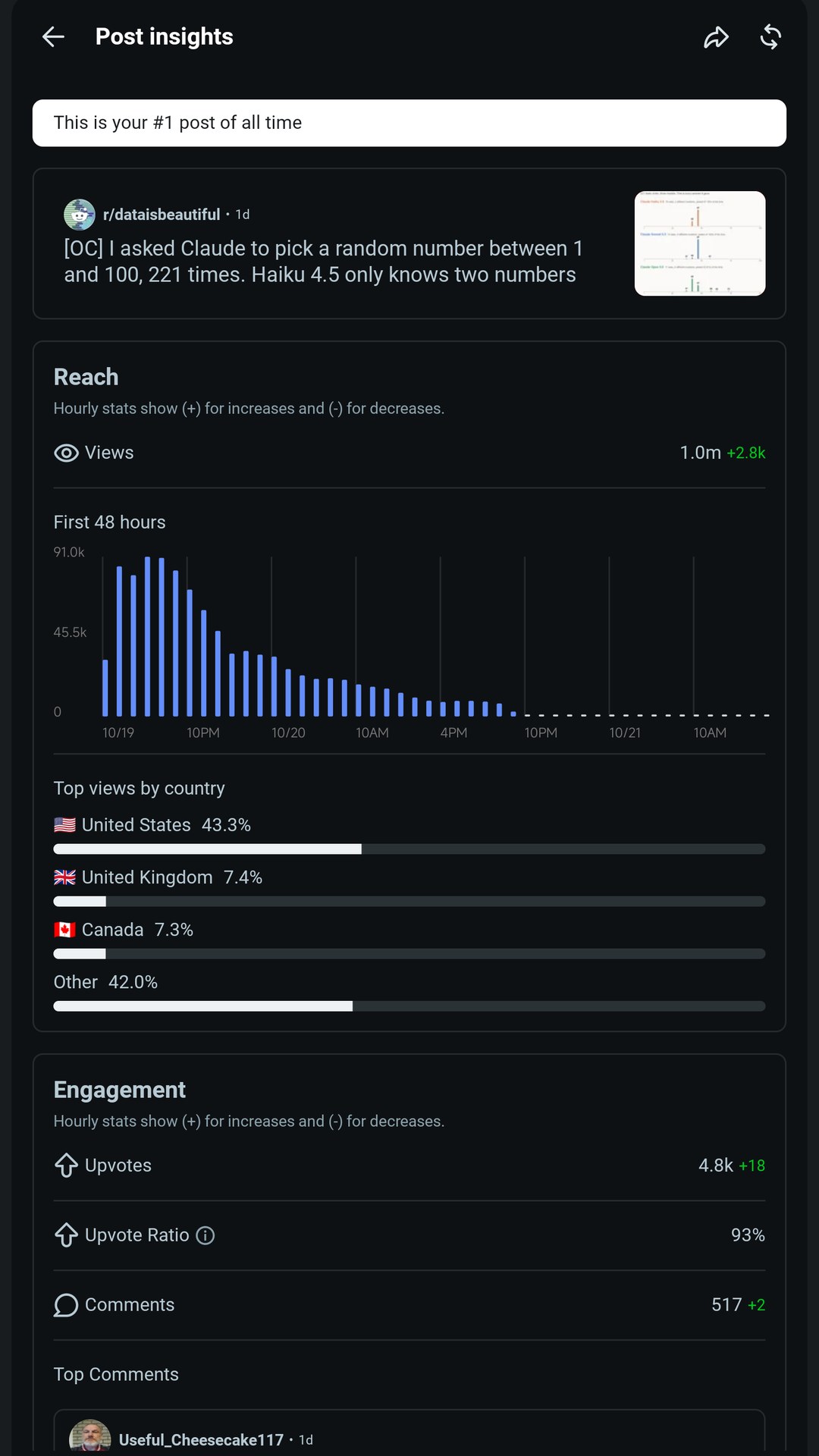
500+ comments, and nobody called it AI slop. One person called it a lazy post. Fair.
It worked because nothing in it could be guessed. Sonnet said 47 in 68 of 74 asks. Haiku only knew two numbers.
A model can write that sentence. Only a real run gives you the 68.
The replies were another story. On 16 October Claude drafted my first batch: tidy, helpful, full sentences, the kind a support team sends. I sent them back. These are the kind that went out after the rewrite:
| Reply that went out | Sub |
|---|---|
| "10 years on upwork is wild lol" | r/Freelancers |
| "yeah i'm kinda coming around to that tbh" | r/freelancing |
A post for r/macbookair was worse. The draft had details that never happened: a reason for skipping Time Machine I never had, and a claim about Siri I never made. They made the story sound real, so Claude wrote them.
I cut both before posting. That's the slop I worry about most, because it's wrong facts with my name on them.
Why AI Ends Up Sounding Like AI
A language model writes one word at a time. Each time, it picks from the words most likely to come next, given everything before it.
Google's own guide, updated in October 2026, puts it plainly: generative models "don't retrieve facts, but predict a likely sequence of words."
My Reddit chart shows it in one number. Asked for a random number, Claude didn't pick at random. It gave the answer that looked most likely, and that was 47.
A whole post works the same way. Likely word after likely word reads smooth and correct, and anyone could have written it. That's the slop.
The words a model can't guess are the ones only you know: the date, the price, what the customer said, what you think. If you don't add them, nothing else will.
Ava Amini explains this in her MIT deep learning class with a word prediction example. The video starts at that part (24:24).
If you'd rather read, start with GLTR, a 2019 tool from researchers at Harvard and IBM (the paper). It colours every word by how high it sat in the model's guesses, and AI text lights up as almost all top guesses.
In their study, people with GLTR spotted generated text 72% of the time. Without it, 54%, close to a coin flip.
What I Tried First: A Humanizer
In August, before any voice file, we tried to fix it with a tool. We ran an international SEO post on mersa.biz through humanizeai.pro's report and rewrote it until it passed all 12 of its checks.
On the same day, with the same text, humanizeai.pro said 100% human and Copyleaks said 100% AI. GPTZero called all seven versions we tried AI.
Worse, the "human" version read like this:
| The humanized opening (August) | The opening today |
|---|---|
| "You don't need hreflang. You have no alternate pages to tell apart. You don't need a country-code domain either." | "Open any international SEO guide and it starts with hreflang, country-code domains and translation. None of that fits a business selling into one other country, in one language." |
| "The map pack is a wall, not a budget problem." | "...except the local map pack, which no budget will change, and the real constraint is trust." |
The same post on mersa.biz, before and after the voice file.
Short fragments in threes. "A wall, not a budget problem." The pass to make it sound human added the exact shapes that sound like AI.
We stopped editing to a score after that.
What's in My Voice File
VOICE.md is about 300 lines in four parts. The rules every channel shares, a ban list, extra rules per channel (blog, Instagram, LinkedIn, Reddit, X, Threads, WhatsApp), and the evidence behind each rule.
Every rule is tagged with where it came from, and the sources have an order. My own edits win. Then my writing and speech. Then three newsletter writers I read for it: Matt Mullenweg, Syed Balkhi and Chris Lema.
The test at the top of the file is one line: would I say this out loud to a clinic owner over coffee?
Here are some of the rules, and where each one came from:
| Rule | Where it came from |
|---|---|
| Round numbers in prose: 7%, not 7.4% | Me, 20 October: "For a human, 7.4 is no different than 7." |
| Two rendered lines per paragraph, at most | Me, 20 October: "why do you write three-line paragraphs like this? Haven't we talked about this?" |
| Three parallel items never run the same length | Me, 18 October, after three definitions came back as triplets |
| Keep my swearing, with one letter starred | Me, 19 October, after it got cut |
| Open on what happened, not a set-up | My edits, plus how Mullenweg and Lema open |
| "Here's the thing" and "In today's..." are banned | The tell list, checked by a script before I see a draft |
The best rules come from comparing my rewrite with Claude's draft. Whatever I changed becomes a rule, so the file updates every time I rewrite something. These three are from a post about Bali clinics in AI answers:
| Claude wrote | I changed it to |
|---|---|
| "Ask whoever runs your website to check it this week." | "Check yours." |
| "So the fair question is whether it holds in Bali... it did." | "That's American data, so I'd take it as a pattern and no more." |
| "Run the 12 questions for your own clinic this week." | Cut. The last line doesn't hand out homework. |
My Words vs the Published Post
The second example is a post on mersa.biz, marketing audit vs SEO audit vs website audit. We wrote it one section at a time, and I dictated the parts only I could add.
Here's one, exactly as FluidVoice typed it:
The joke has numbers behind it now. Arena compared answers from Opus 5 and Opus 5.5, and em dashes fell from 15.2 to 0.8 per 1,000 words, about 95% fewer (BleepingComputer).
Anthropic says Opus 5.5 "follows the writing rules you give it" (Anthropic). That helps a voice file a lot.
I still keep "no em dashes" in mine. 0.8 isn't zero.
The longer one was about website audits. I said it fast, swearing included:
...it's very hard to just put your hands on a design or a functionality and say this is bad. You should change it. This is absolutely f*cking bad. I mean, you can't do it.
In the article it became:
...it's very hard to point at a design or a feature and say it's absolutely f*cking bad and has to change. The client won't like it, and it isn't true either. The website is working.
The point, the swearing and "who made this garbage" stayed. What went: "I mean", "I'm not gonna lie" turned into "I'm not going to lie", and a run-on split in three.
FluidVoice: Why I Talk to Claude Now
FluidVoice is a free, open source dictation app for the Mac by a solo developer (GitHub). The speech model runs on the Mac itself, so the audio isn't sent anywhere to be transcribed.
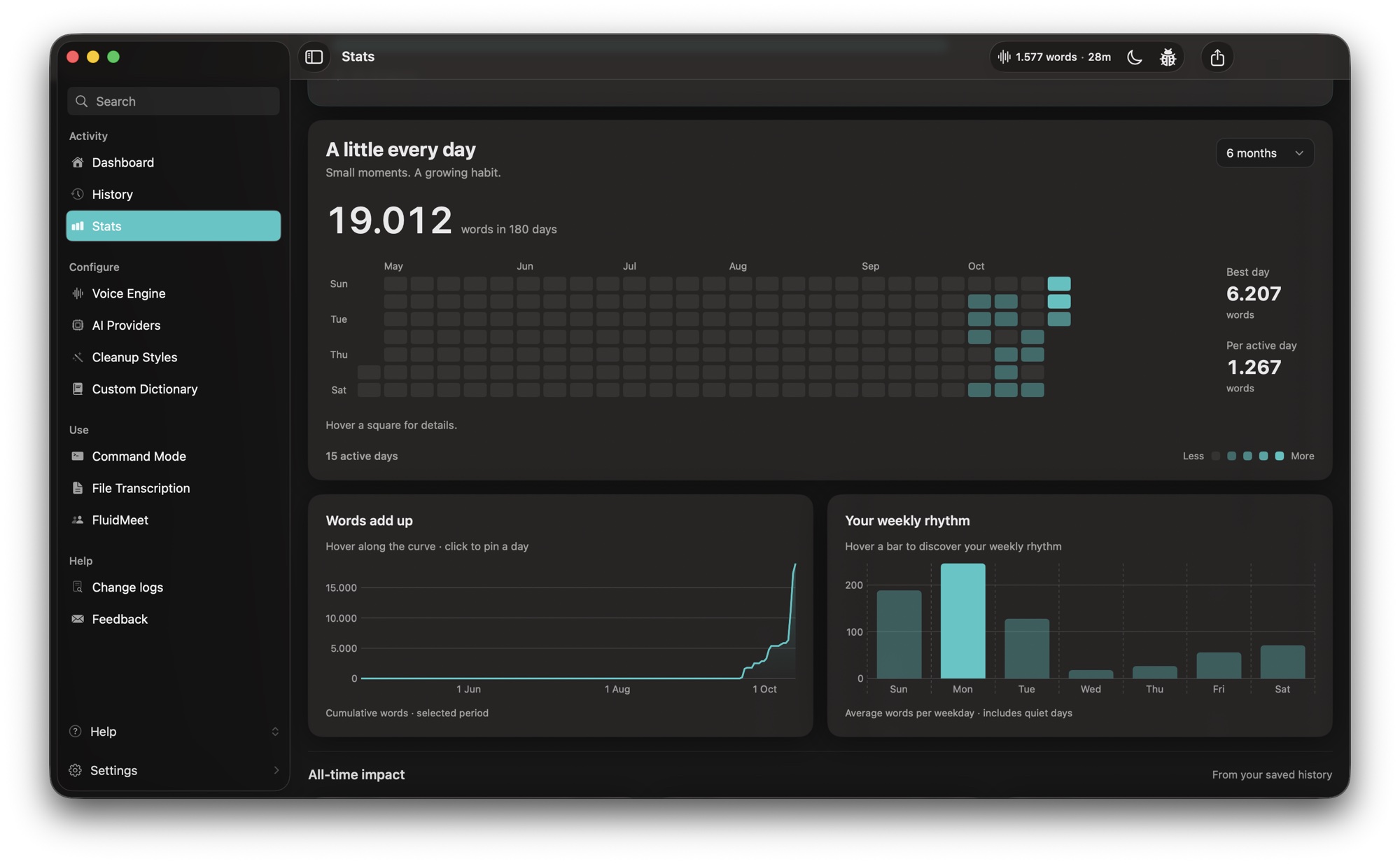
I started using FluidVoice on 12 September. The stats only start on 28 September, the week macOS 27 drained my battery so badly that I wiped my Mac.
I stayed up until 5am backing up by hand (I posted about it on r/MacOS). The wipe reset FluidVoice, so I started over from zero.
Luckily I'd saved my transcripts first, and the first version of my voice file was built from those.
Since the wipe it's 19,012 words over 15 active days, 1,267 on an average day and 6,207 on my best one. Mondays are the heaviest, which tells you when I plan the week.
Nearly all of it goes to Claude. Talking is faster than my typing, and a long prompt costs me nothing extra, so I explain more. More context in, less slop out.
Claude Code has its own voice mode now. I still use FluidVoice, because one press of the Option key starts it in any app.
While I talk, I can keep browsing. A small bar floats over whatever page I'm on, so I see the words as they come in.
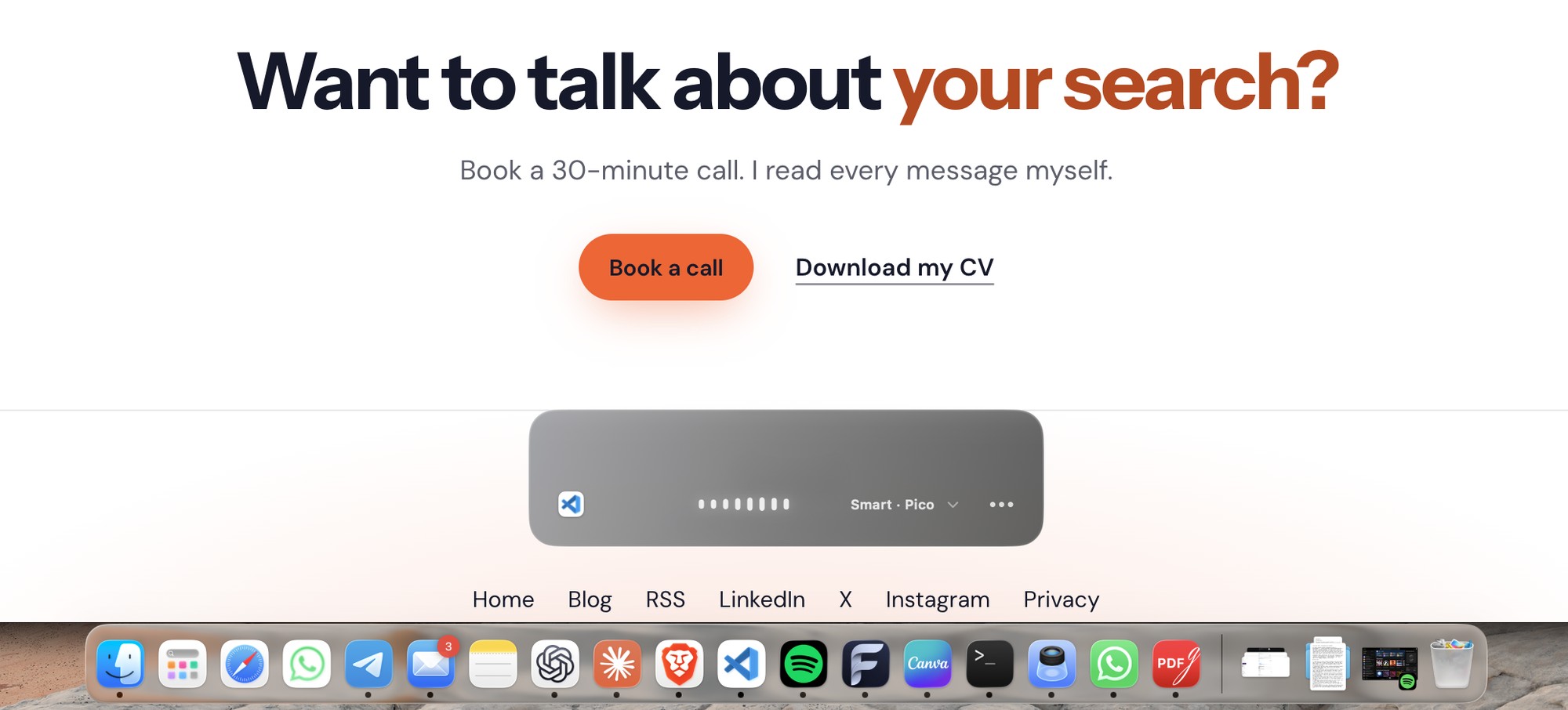
Then I click back into Claude Code and press Option again. The whole transcript pastes in for me, with nothing to copy.
Here's one from tonight. "Let's have the dark mode switcher for the other landing pages in the website too." Transcribed in 103 ms, cleaned up in 253 ms, and the recording isn't saved.
My setup, if you want to copy it:
| Setting | What I use |
|---|---|
| Voice engine | Blazing Fast English, NVIDIA Parakeet TDT v2, about 443 MB, Apple Silicon |
| Cleanup | Fluid 1 Pico, on the Mac, "smallest and fastest" |
| Cleanup style | Smart, the built-in one |
| Audio | Not saved |
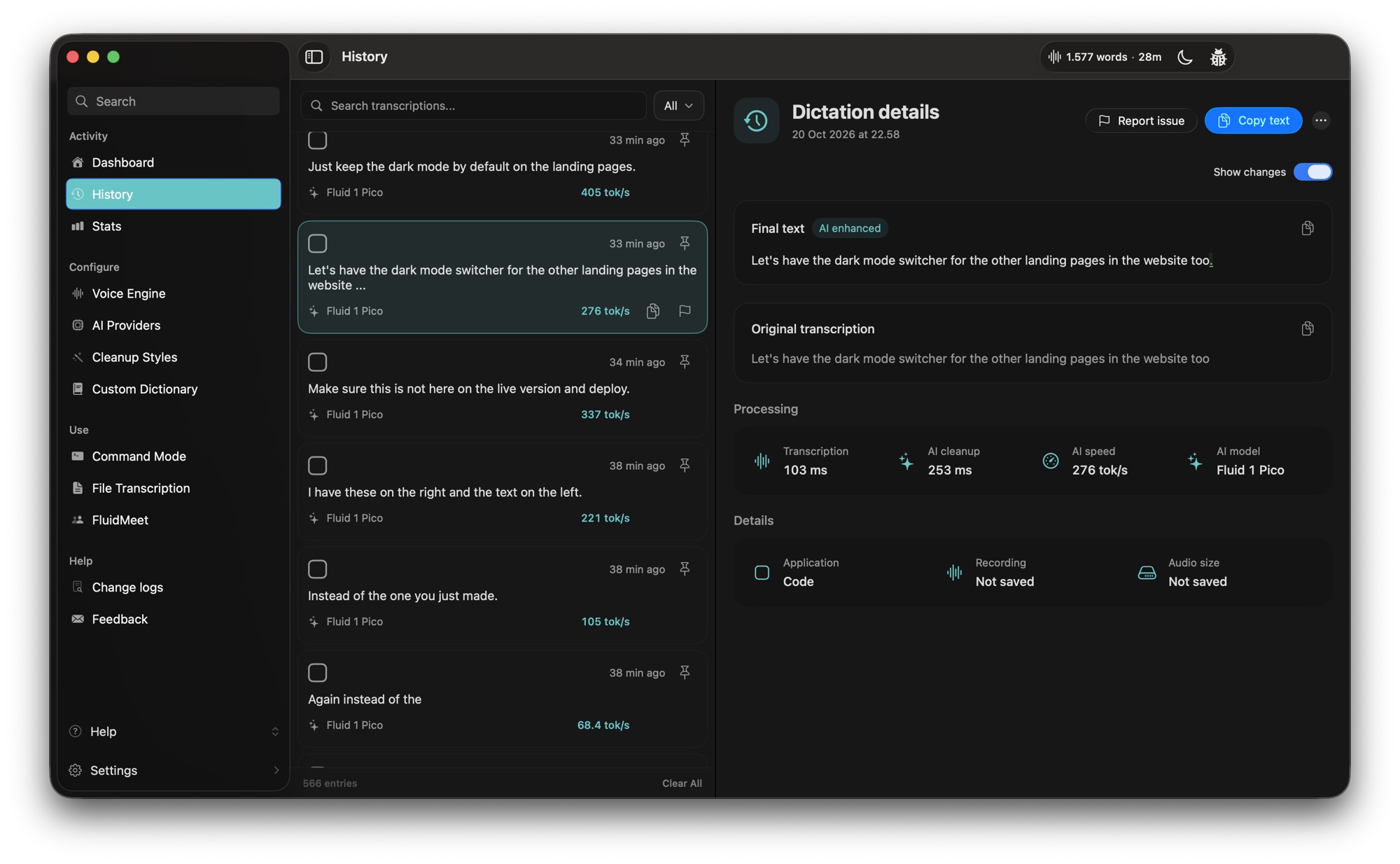
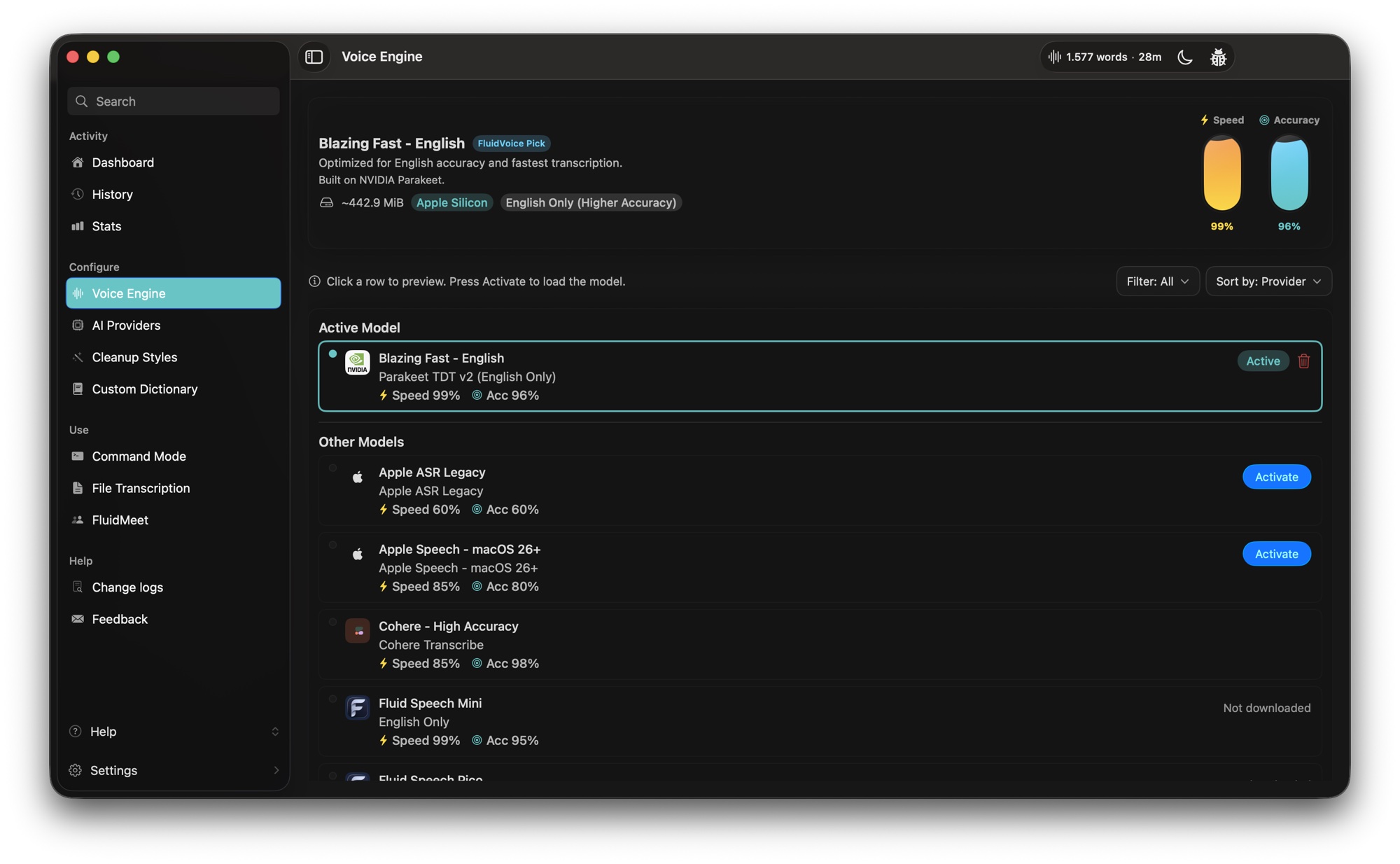
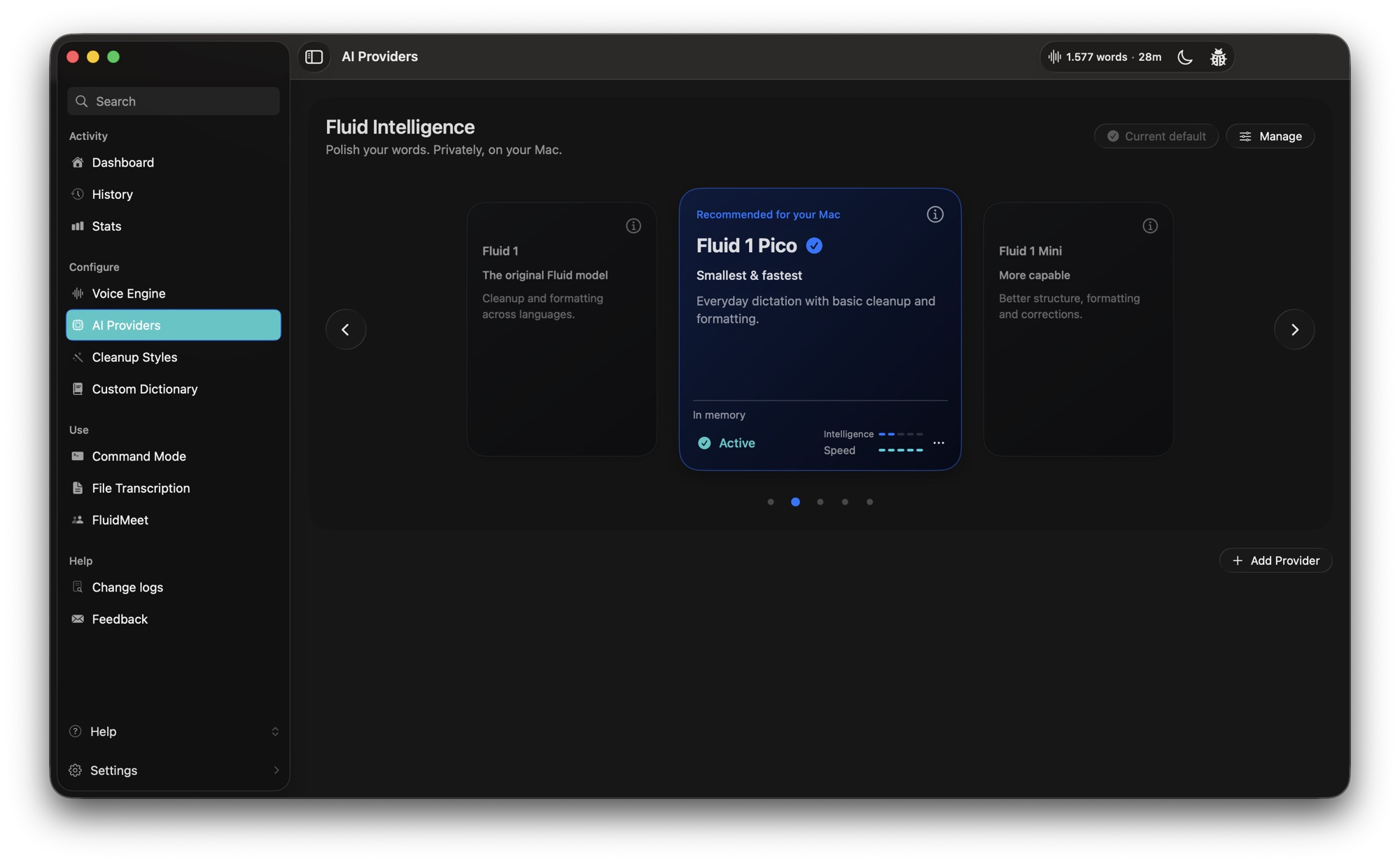
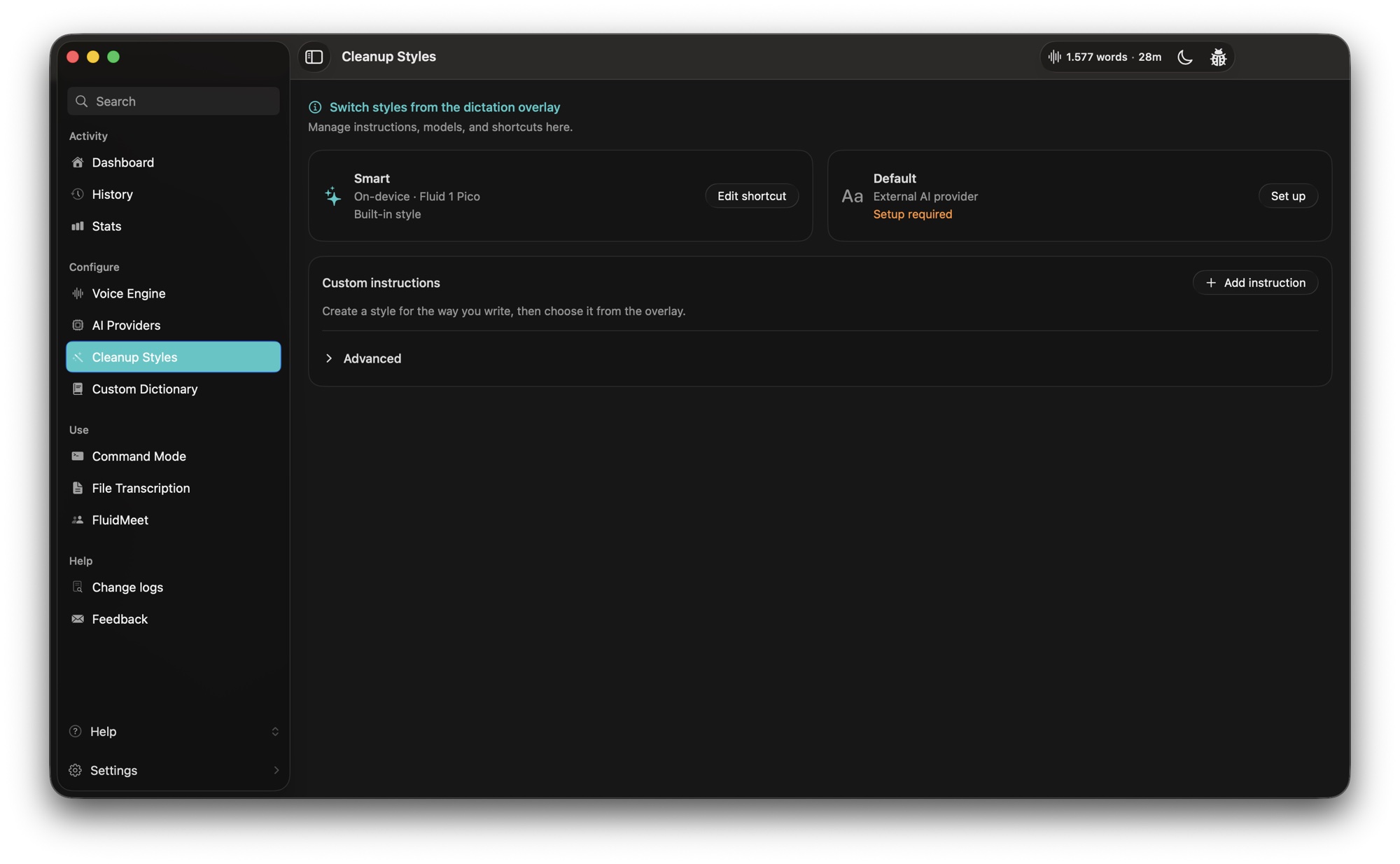
One honest catch: it hears what I say, not what I mean. "Opus Fine 5.5" made it into a prompt. Claude reads through that easily. A client email needs a second look.
My Dictations Became the Voice Data
This part I didn't plan. FluidVoice keeps a history, so every prompt I spoke was also a sample of how I talk.
Claude read 552 of them, 20,037 words. It found how I argue. I give the usual view first, then turn. I set the situation in one sentence before I ask for anything. I say "so we can" to give the reason.
It also counted the habits that work in speech and fail in print:
| What I say | Times in 433 dictations | On the page |
|---|---|---|
| "just" | 107 | Only where it's plain speech, like "just three clinics" |
| "Alright" | 55 | Cut. Start with the point |
| "I mean" | 34 | Cut. Say the corrected version |
| "I don't know" | 23 | Once per post, as the one honest gap |
| "Here's the thing" | 6 | Banned. It's a teaser hook |
Counts from my FluidVoice dictations, 17 to 20 October 2026.
My spoken sentences run 25 words on average, so the file says to split them. It keeps one long sentence per paragraph, because that one sounds like me.
Does It Pass a Detector?
Most detectors measure that same guessing: how many of your words sat in the model's top guesses. Fewer means more human.
We measured the audit post against two posts each by Chris Lema and Matt Mullenweg, and an AI draft of the same section:
| Words outside GPT-2's top 100 | Perplexity | Binoculars | |
|---|---|---|---|
| Lema and Mullenweg | 9-18% | 13-28 | 1.00-1.03 |
| AI draft of the same section | 6-7% | 3-4 | 0.73-0.74 |
| The audit post, in my voice | 11-18% | 27-42 | 0.99-1.07 |
Measured 18 October 2026 on the post's first two sections. Higher means less predictable on all three.
It lands with the human writers. I'd still take that as a check and no more.
A 2026 study ran 13 detectors on human writing by non-native English speakers, and their false alarms ranged from 0% to 100% (Park et al., 2026). A score can't be the goal.
Google doesn't ask for a score either. Its guide to AI content, updated on 1 October 2026, says AI can be "particularly useful when researching a topic" (Google Search Central).
What it asks for is this: "It is critical to manually factcheck and review all AI-generated content" before publishing. Pages made in bulk without adding value count as spam.
So the work that counts is the human part: checking every claim, adding what only you know, and cutting what you'd never say.
Build Your Own Voice File
You can start from mine. The file you download holds the rules I've made, with my transcripts and private notes taken out. Your transcripts are the part that makes it sound like you.
So keep the rules, and build the voice part the way I did:
- Start from my rules. Download the file and delete what doesn't fit your work. The ban list and the rhythm rules work for anyone.
- Save how you talk. Dictate your prompts for a week; FluidVoice keeps the history. Then give Claude the transcripts and ask how you argue, what you repeat, and which habits should stay off the page. Here's roughly what I said to Claude Code:
My prompt, cleaned up a little. The numbers in the reply are from my real run.
- Keep every edit. When you rewrite a draft, give the AI both versions and ask what rule your changes show. Add it to the file with the date and your words. Most of my file came from this step, and nobody can copy it, because the edits are yours.
- Add one test line to the top. Mine is the clinic owner over coffee.
- Update it every time you rewrite. Mine got new rules on 18, 19 and 20 October.
What's the one line that makes you close a post the moment you read it?
Common Questions
Can a humanizer tool make AI writing pass as human?
Not reliably. One mersa.biz post scored 100% human on humanizeai.pro and 100% AI on Copyleaks on the same day in August 2026, and GPTZero called all seven versions of it AI.
Is FluidVoice free to use on a Mac?
Yes. FluidVoice is free and open source under the GPL-3.0 license. Its Parakeet speech model runs on the Mac itself, so the audio isn't sent away to be transcribed. Apple Silicon is recommended.
What should go in a voice file for Claude or ChatGPT?
Rules from your own edits first, then habits from how you talk, then a short ban list. Tag each rule with where it came from, and update the voice file every time you rewrite a draft.
Does Google penalise blog posts written with AI?
No, not for being written with AI. Google's guide to AI content, updated in October 2026, asks you to fact-check and review all AI-generated content by hand. Mass-producing pages that add no value counts as spam.
Does dictating prompts to Claude work better than typing them?
For me, yes. Spoken prompts run longer and carry more context. My 566 FluidVoice dictations average about 34 words each, and a typical sentence is transcribed in about 100 milliseconds.
